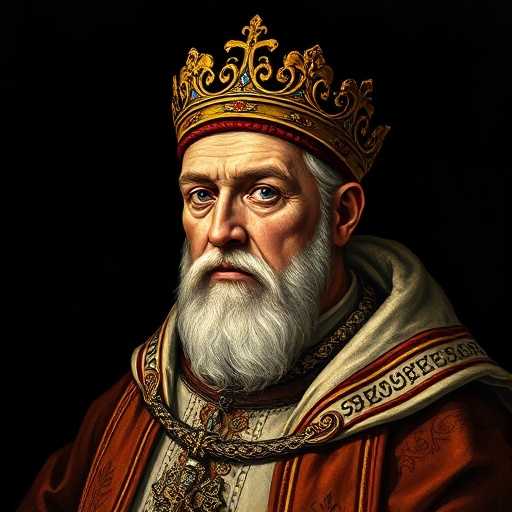
Pope Urban II — "Let those who have been serving as mercenaries for small pay now obtain the eter…"
Let those who have been serving as mercenaries for small pay now obtain the eternal reward.
Let those who have been serving as mercenaries for small pay now obtain the eternal reward.
Click any product to generate a realistic preview. Up to 3 at a time.
* Initial load can take up to 90 seconds — revising the preview in another color is nearly instant.
"The land of the Saracens is fertile and rich."
"Go forth, therefore, and fear not; for the Lord God of hosts will be with you."
"Go forth, therefore, and cleanse the Holy Sepulchre from the wicked race."
"Let no one who has entered upon this pilgrimage turn back."
"The royal city, situated at the center of the world, is now held captive by His enemies, and is enslaved by peoples who do not know God."
Pope (1088-1099) whose Council of Clermont speech (November 1095) launched the First Crusade — the founding event of nine centuries of Christian-Muslim military conflict. Closely associated with Pope Gregory VII (his predecessor on papal-imperial reform). For an intellectual contrast, see Saladin, Kurdish-Muslim Sultan of Egypt and Syria (1138-1193) — Saladin recaptured Jerusalem in 1187, undoing the First Crusade Urban II launched 92 years earlier. Saladin's chivalrous treatment of Christian prisoners became the canonical Muslim counter-image to Crusader brutality. The cleanest before/after pairing of the Crusades' moral arc.
Speech at the Council of Clermont, promising spiritual benefits for participating in the Crusade.
Date: 1095
BiblicalFound in 1 providers: gemini
1 source checked
This quote redirects soldiers from fighting for earthly wages to fighting for God's cause in exchange for spiritual salvation. Urban II tells mercenaries — men who sell their swords for coin — that the Crusade offers something money cannot buy: eternal life. It reframes military violence as sacred duty, transforming a commercial transaction into a divine investment with heaven as the ultimate payment.
Urban II, a Benedictine monk turned pope, understood that Europe's warrior class was both a threat and a resource. As architect of the First Crusade at the Council of Clermont in 1095, he needed to convert mercenary violence into holy war. His deep investment in Gregorian Reform — spiritualizing secular life — drove him to offer warriors a path to salvation through combat, channeling restless swords away from internal Christian conflict toward Jerusalem.
In 1095, professional mercenaries and landless knights roamed Europe selling their violence for survival wages. The Seljuk Turks had seized Jerusalem and crushed Byzantine forces at Manzikert in 1071, prompting Emperor Alexios I to beg Rome for aid. The Church's Peace of God movement had failed to curb knightly brutality at home. Urban II's masterstroke was exporting that violence eastward, promising eternal reward where earthly lords offered only temporary coin.
AI-generated insights based on extensive research and information for context. Factual errors? Email [email protected].
Your cart is empty