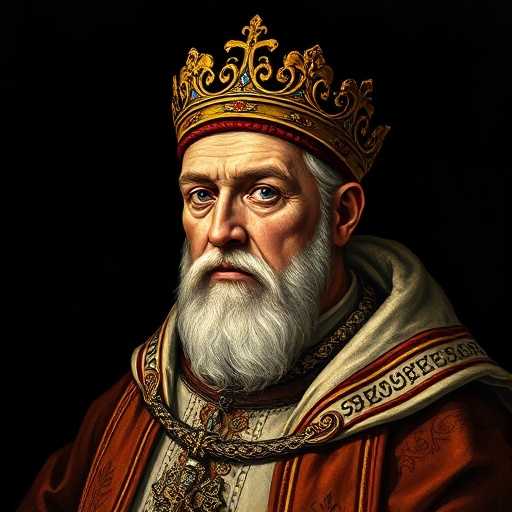
Pope Urban II — "Go forth, therefore, and cleanse the Holy Sepulchre from the wicked race."
Go forth, therefore, and cleanse the Holy Sepulchre from the wicked race.
Go forth, therefore, and cleanse the Holy Sepulchre from the wicked race.
Click any product to generate a realistic preview. Up to 3 at a time.
* Initial load can take up to 90 seconds — revising the preview in another color is nearly instant.
"That land, as the Scripture says, 'floweth with milk and honey,' and Jerusalem is the navel of the world."
"Christian blood, redeemed by the blood of Christ, has been shed, and Christian flesh, akin to the flesh of Christ, has been subjected to unspeakable degradation and servitude."
"You are called shepherds; see that you do not act as hirelings. But be true shepherds, with your crooks always in your hands. Do not go to sleep, but guard on all sides the flock committed to you. For…"
"Let your arms be stained with the blood of the infidels."
"Let no delay postpone the journey."
Pope (1088-1099) whose Council of Clermont speech (November 1095) launched the First Crusade — the founding event of nine centuries of Christian-Muslim military conflict. Closely associated with Pope Gregory VII (his predecessor on papal-imperial reform). For an intellectual contrast, see Saladin, Kurdish-Muslim Sultan of Egypt and Syria (1138-1193) — Saladin recaptured Jerusalem in 1187, undoing the First Crusade Urban II launched 92 years earlier. Saladin's chivalrous treatment of Christian prisoners became the canonical Muslim counter-image to Crusader brutality. The cleanest before/after pairing of the Crusades' moral arc.
Found in 1 providers: grok
1 source checked
A religious authority commands followers to march to Jerusalem and retake the Church of the Holy Sepulchre — the tomb Christians believe held Christ's body — through military force. The word 'cleanse' frames violence as sacred purification, while 'wicked race' dehumanizes Muslims as enemies of God rather than people. In plain terms: a leader weaponizing religious identity to justify conquest by recasting political ambition as divine obligation.
Urban II, a Benedictine monk turned pope, spent his papacy reforming a corrupt Church and asserting Rome's authority over secular rulers. He saw the Crusade as achieving several goals simultaneously: redirecting Europe's violent knightly class, reuniting with Eastern Christianity after the 1054 Schism, and cementing papal supremacy over kings. This quote embodies his core method — translating worldly power struggles into spiritual imperatives, the defining strategy of his entire pontificate.
In 1095, Seljuk Turks controlled Jerusalem and had disrupted Christian pilgrimages to sacred sites. Byzantine Emperor Alexios I appealed to Rome for military aid against them. European knights, bred for war but ravaging their own neighbors, needed redirection. The Church's just-war doctrine held that violence in God's service could erase sin. Urban's Clermont speech fused these pressures perfectly: offer soldiers guaranteed salvation, name an enemy, and mobilize a continent.
AI-generated insights based on extensive research and information for context. Factual errors? Email [email protected].
Your cart is empty