Isaac Newton — "This most beautiful system of the sun, planets and comets, could only proceed fr…"
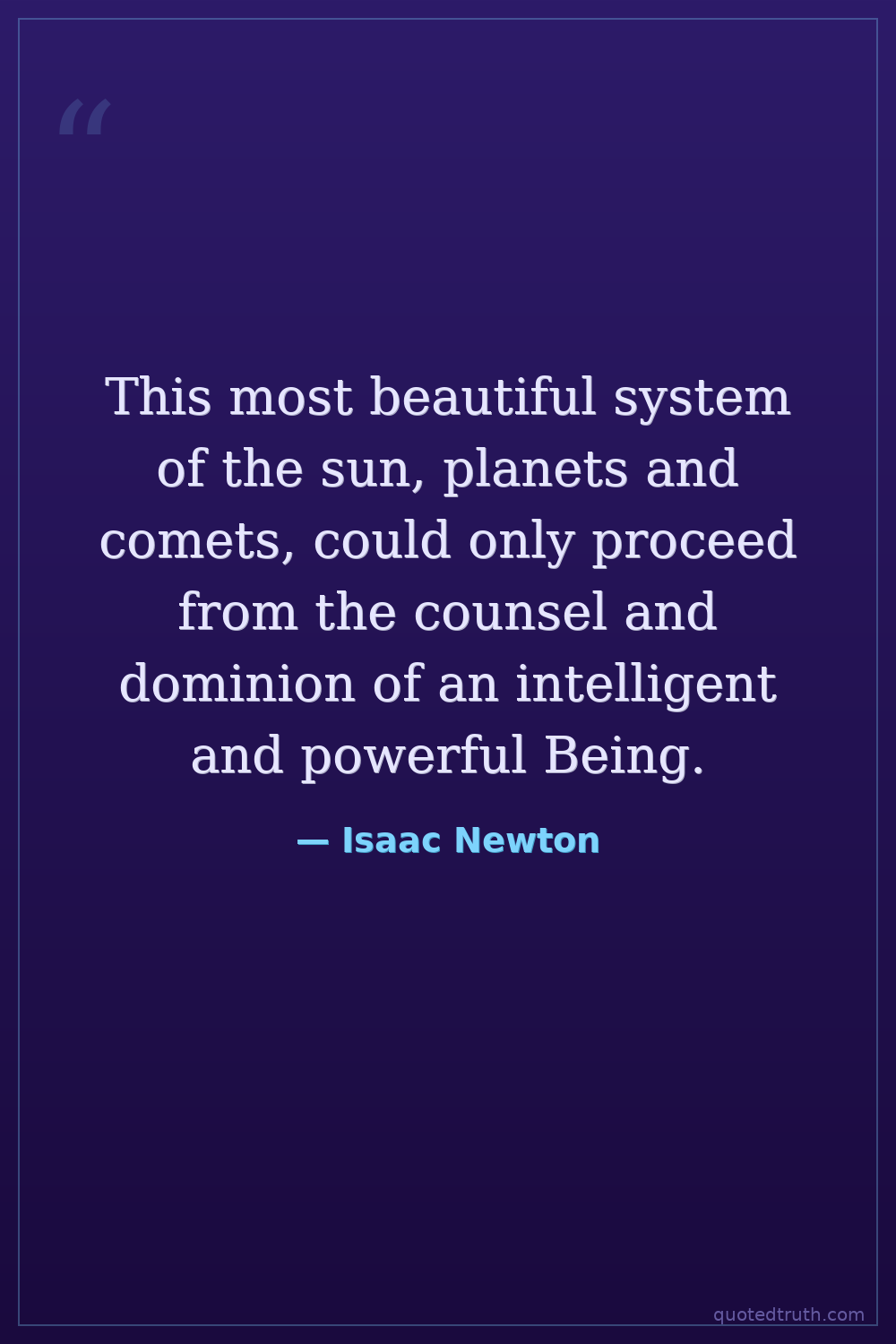
This most beautiful system of the sun, planets and comets, could only proceed from the counsel and dominion of an intelligent and powerful Being.
This most beautiful system of the sun, planets and comets, could only proceed from the counsel and dominion of an intelligent and powerful Being.
Click any product to generate a realistic preview. Up to 3 at a time.
* Initial load can take up to 90 seconds — revising the preview in another color is nearly instant.
"I feign no hypotheses."
"He who thinks half-heartedly will not believe in God; but he who thinks seriously will believe in God, and will not doubt that God is the author of the world."
"We build too many walls and not enough bridges."
"If I am anything, which I highly doubt, it is due to hard work."
"Truth is ever to be found in simplicity, and not in the multiplicity and confusion of things."
Reflecting on the divine origin of the cosmos.
Date: Approximate, from his scientific or theological works
Nature & WorldFound in 3 providers: gemini,grok,deepseek
3 sources checked
The universe's precise, ordered structure — the solar system running by mathematical laws — is so elegant and complex that it could not have emerged by accident or blind mechanism. Only a supremely intelligent and powerful creator could have designed and continues to govern it. Newton treats the observable beauty of cosmic order as direct evidence for the existence of God.
Newton discovered the gravitational laws governing planetary orbits, making him uniquely qualified to marvel at their precision. He wrote over a million words on theology alongside his science. This line appears in the General Scholium of his Principia Mathematica (1687). Newton explicitly rejected a self-sustaining mechanical universe, insisting God actively maintains cosmic order — his faith and physics were inseparable throughout his entire life.
The 17th-century Scientific Revolution had dismantled the Earth-centered medieval cosmos. Copernicus, Galileo, and Kepler reordered the heavens, raising urgent questions about whether God remained necessary. Descartes and materialist philosophers proposed a self-operating mechanical universe requiring no divine hand. Newton's era demanded a theological response, and his physics argued that science's deepest findings pointed toward rather than away from an active, governing creator.
AI-generated insights based on extensive research and information for context. Factual errors? Email [email protected].
Your cart is empty