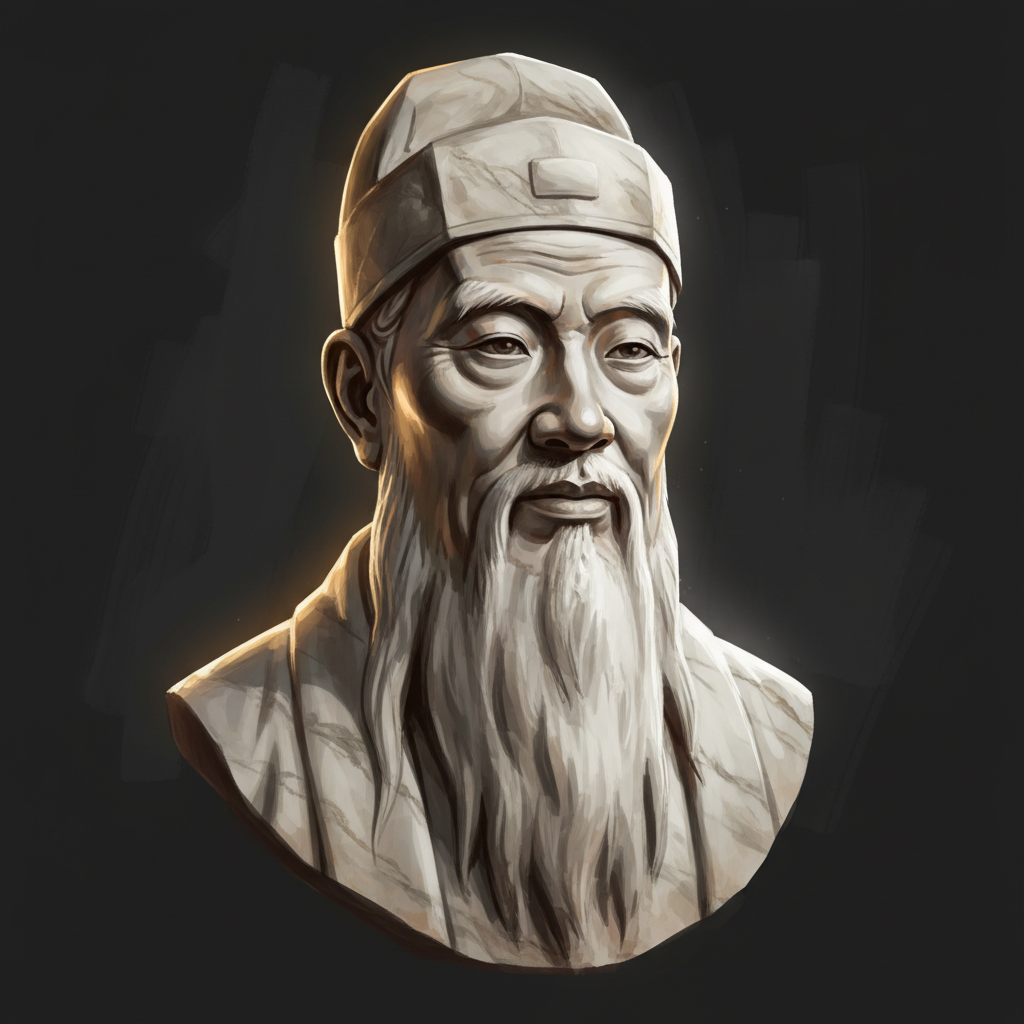
Confucius — "To worship ancestors whom one does not know is to be presumptuous."
To worship ancestors whom one does not know is to be presumptuous.
To worship ancestors whom one does not know is to be presumptuous.
Click any product to generate a realistic preview. Up to 3 at a time.
* Initial load can take up to 90 seconds — revising the preview in another color is nearly instant.
"When the self is cultivated, the family will be in harmony. When the family is in harmony, the state will be well-governed. When the state is well-governed, the world will know peace."
"The superior man thinks of virtue; the small man thinks of comfort."
"The Master said, 'What I want to avoid is fixed ideas, obstinacy, narrow-mindedness, and egoism.'"
"The Master said, 'The wise man delights in water, the benevolent man delights in mountains. The wise man is active; the benevolent man is tranquil. The wise man is joyful; the benevolent man is long-l…"
"The Master said, 'He who is not concerned about the distant future will find trouble right at hand.'"
Chinese philosopher and teacher whose teachings (compiled by his students in the Analects) became the foundational ethical framework of East Asian civilization for 2,500 years. Closely associated with Mencius (his most-influential follower a century later). For an intellectual contrast, see Laozi, near-contemporary Chinese sage and Tao Te Ching author — Confucius systematized social order through ritual and family hierarchy; Laozi's Taoist effortless-action philosophy argued such systems were the disease, not the cure. The two founding poles of Chinese moral philosophy — every East Asian moral tradition since has positioned itself between them.
The standard scholarly entry points to Confucius's work: Philip J. Ivanhoe (Georgetown, Chinese philosophy) — Confucian Moral Self Cultivation (2000); Edward Slingerland (UBC, Asian Studies) — Effortless Action: Wu-wei as Conceptual Metaphor (2003); Tu Weiming (Harvard, Confucian scholar) — Confucian Thought: Selfhood as Creative Transformation (1985). These are the works graduate seminars cite when teaching Confucius.
Found in 1 providers: grok
1 source checked
Honoring ancestors you know nothing about is a hollow performance. Ritual without real connection or understanding becomes empty display, even arrogance. Genuine reverence requires knowledge of who the person was, what they valued, and how their life mattered. Going through motions to appear dutiful, without that grounding, substitutes vanity for respect. Sincere devotion depends on substance, not ceremony performed for show or social credit.
Confucius built his teaching around li (ritual propriety) and filial piety, but insisted inner sincerity must match outward rite. He famously said sacrificing to spirits not your own is flattery. As a scholar who studied ancient Zhou traditions meticulously, he modeled the knowledge-before-ritual principle. Empty ceremonialism contradicted his core belief that ren (humaneness) and authenticity were the soul of every observance.
During the Spring and Autumn period (6th-5th century BCE), Zhou dynasty authority was crumbling and rival states performed elaborate ancestral rites for political legitimacy rather than genuine piety. Nobles claimed glorious lineages to justify power. Confucius witnessed ritual inflation everywhere, with ceremonies divorced from moral substance. His push for studied, sincere observance challenged rulers who weaponized ancestor worship as propaganda in an increasingly cynical age of warring states.
AI-generated insights based on extensive research and information for context. Factual errors? Email [email protected].
Your cart is empty