Confucius — "The Master said, 'The student of virtue has no anxieties; the man of wisdom has …"
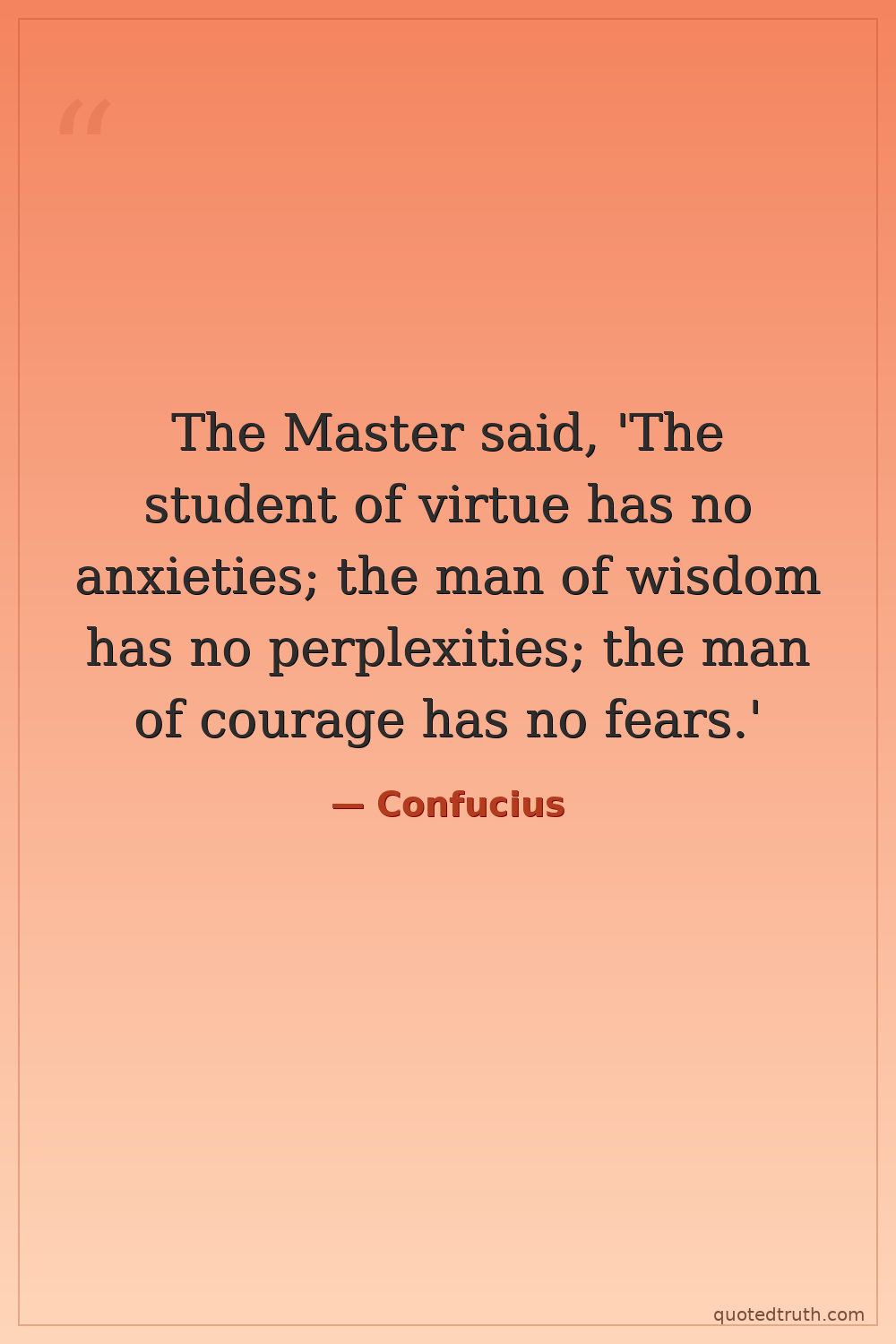
The Master said, 'The student of virtue has no anxieties; the man of wisdom has no perplexities; the man of courage has no fears.'
The Master said, 'The student of virtue has no anxieties; the man of wisdom has no perplexities; the man of courage has no fears.'
Click any product to generate a realistic preview. Up to 3 at a time.
* Initial load can take up to 90 seconds — revising the preview in another color is nearly instant.
"The Master said, 'If the will be set on virtue, there will be no practice of wickedness.'"
"First he behaves properly and then he speaks, so that his words follow his actions."
"Do not be desirous of having things done quickly; do not look at small advantages. Desire to have things done quickly prevents their being done thoroughly. Looking at small advantages prevents great a…"
"The superior man, in the world, does not set his mind either for anything, or against anything; what is right he will follow."
"The noble-minded are calm and steady. Little people are forever fussing and fretting."
Chinese philosopher and teacher whose teachings (compiled by his students in the Analects) became the foundational ethical framework of East Asian civilization for 2,500 years. Closely associated with Mencius (his most-influential follower a century later). For an intellectual contrast, see Laozi, near-contemporary Chinese sage and Tao Te Ching author — Confucius systematized social order through ritual and family hierarchy; Laozi's Taoist effortless-action philosophy argued such systems were the disease, not the cure. The two founding poles of Chinese moral philosophy — every East Asian moral tradition since has positioned itself between them.
The standard scholarly entry points to Confucius's work: Philip J. Ivanhoe (Georgetown, Chinese philosophy) — Confucian Moral Self Cultivation (2000); Edward Slingerland (UBC, Asian Studies) — Effortless Action: Wu-wei as Conceptual Metaphor (2003); Tu Weiming (Harvard, Confucian scholar) — Confucian Thought: Selfhood as Creative Transformation (1985). These are the works graduate seminars cite when teaching Confucius.
Found in 1 providers: grok
1 source checked
A person grounded in moral integrity stays calm because their conscience is clear. Someone with genuine wisdom isn't confused by hard choices because they understand how things work and can weigh options. A truly brave person doesn't freeze up in danger because courage has already settled their nerves. Virtue, wisdom, and courage each remove a specific mental burden: worry, confusion, and fear.
Confucius built his entire teaching around cultivating the junzi, or exemplary person, defined by ren (humaneness), zhi (wisdom), and yong (courage). As a teacher who traveled between warring states seeking rulers who would listen, he lived this himself: rejected repeatedly, he kept his composure, kept studying, and kept traveling. This triad captures the inner life he tried to model and instill in students like Yan Hui and Zilu.
Confucius lived during the late Spring and Autumn period (551–479 BCE), an era of collapsing Zhou authority, constant interstate warfare, assassinations, and moral disorder. Rulers rose and fell by force, and ordinary people faced genuine danger, anxiety, and confusion about right conduct. Against that chaos, Confucius argued that stable character, not political power or ritual alone, was what produced a person who could function without being unmade by the times.
AI-generated insights based on extensive research and information for context. Factual errors? Email [email protected].
Your cart is empty