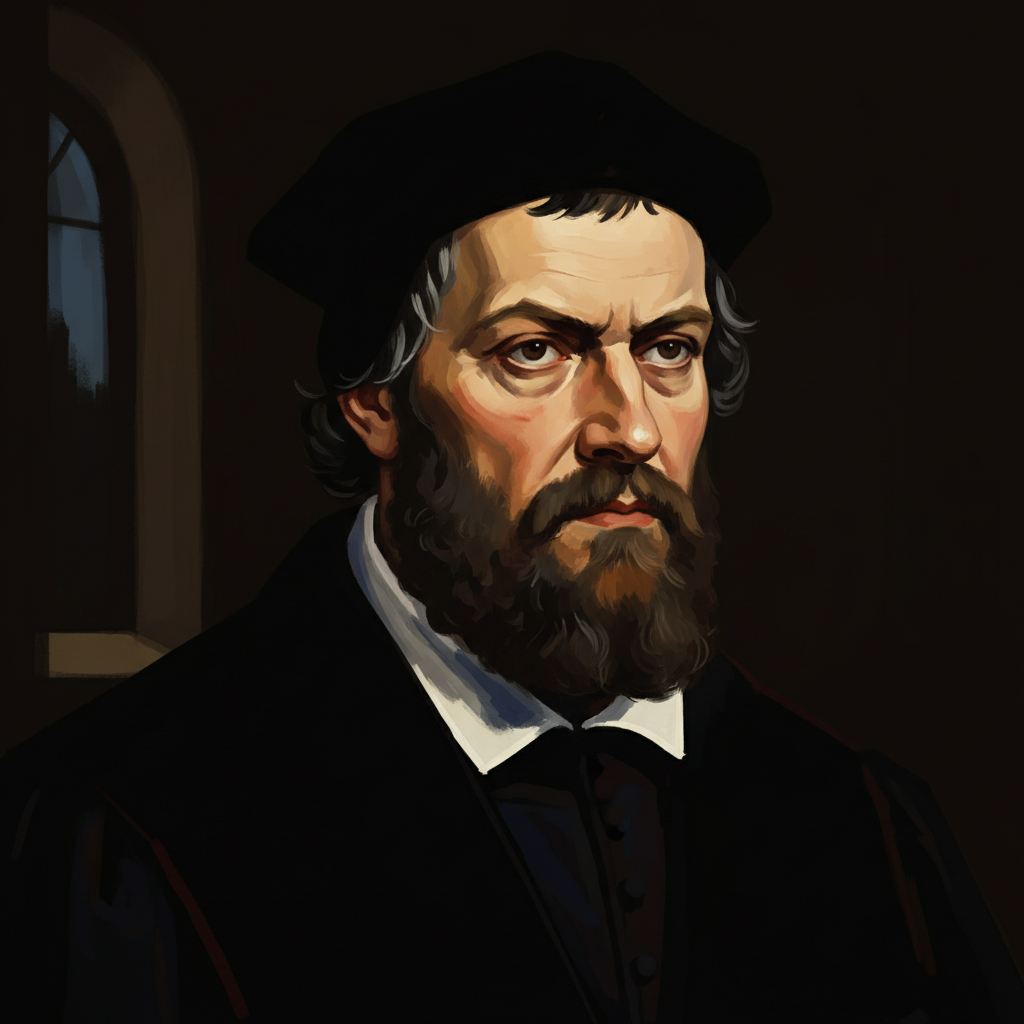
Martin Luther — "I never learned anything by being told, but only by doing."
I never learned anything by being told, but only by doing.
I never learned anything by being told, but only by doing.
Click any product to generate a realistic preview. Up to 3 at a time.
* Initial load can take up to 90 seconds — revising the preview in another color is nearly instant.
"The Turks are the rod of the wrath of the Lord our God."
"A man must have a good digestion to be a good preacher."
"The mad mob does not ask how it could be better, only that it be different. And when it then becomes worse, it must change again."
"The whole being of any Christian is faith and love."
"If you want to change the world, pick up your pen."
German theologian whose 95 Theses (1517) launched the Protestant Reformation and broke the Catholic Church's monopoly on Western Christianity. Closely associated with Philipp Melanchthon (Lutheran systematizer) and John Calvin (later Reformer who built on Luther's break). For an intellectual contrast, see Pope Leo X, Renaissance pope (1513-1521) — Leo X's indulgence sales triggered Luther's break and Leo excommunicated him in 1521 — Luther's entire Reformation is structured as a direct answer to the indulgence-funded Vatican Leo represented.
Found in 1 providers: grok
1 source checked
Real understanding comes from action and experience, not from passive listening or being lectured. Hearing instructions about how to do something gives you information, but you only truly absorb a skill or truth when you try it yourself, make mistakes, and work through them firsthand. Practice builds knowledge in a way that words alone never can, because doing forces engagement while being told allows the mind to drift.
Luther learned theology not by passively accepting church teaching but by wrestling with scripture directly, translating the Bible into German so ordinary people could engage it themselves. His 95 Theses came from lived pastoral frustration with indulgences, not abstract lecture. As a former Augustinian monk turned reformer, he discovered justification by faith through personal struggle, embodying his conviction that conscience and experience outrank inherited authority.
In early sixteenth-century Europe, learning meant memorizing Latin texts and deferring to scholastic authorities and clerical hierarchy. The printing press was just breaking that monopoly, letting ordinary people read scripture themselves. Luther's 1517 challenge to Rome ignited the Reformation precisely because laypeople could now test church claims against the Bible firsthand. His emphasis on direct, hands-on engagement with faith mirrored a broader cultural shift from received tradition toward personal verification.
AI-generated insights based on extensive research and information for context. Factual errors? Email [email protected].
Your cart is empty