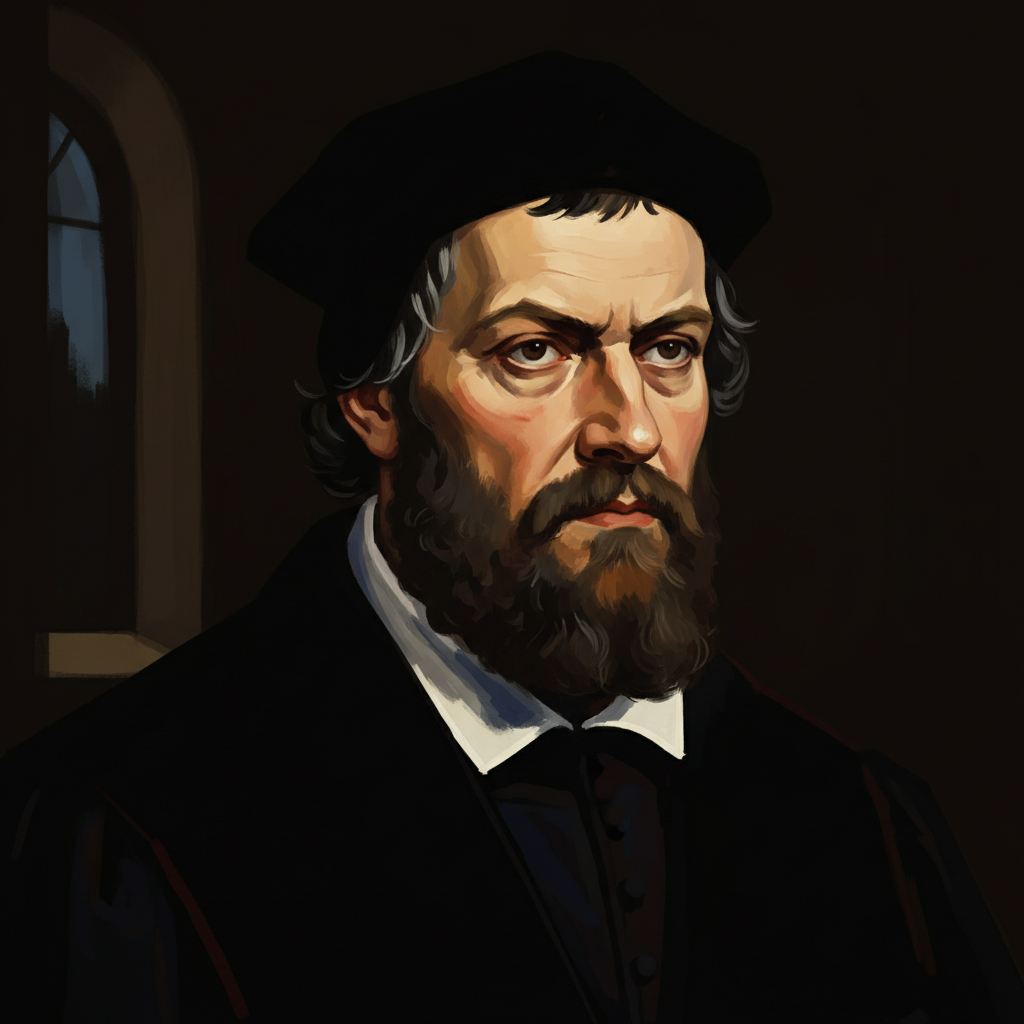
Martin Luther — "The whole being of any Christian is faith and love."
The whole being of any Christian is faith and love.
The whole being of any Christian is faith and love.
Click any product to generate a realistic preview. Up to 3 at a time.
* Initial load can take up to 90 seconds — revising the preview in another color is nearly instant.
"Faith is a living, daring confidence in God's grace, so sure and certain that a man could stake his life on it a thousand times."
"It is a sin to be sad."
"And should the peasants prevail (which God forbid!),... yet surely they who are found, sword in hand, shall perish in the wreck with clear consciences, leaving to the devil the kingdom of this world a…"
"A dog is a dog, and a cat is a cat, but a man is a man."
"We are not yet what we shall be, but we are growing toward it, the process is not yet finished, but it is going on, this is not the end, but it is the road."
German theologian whose 95 Theses (1517) launched the Protestant Reformation and broke the Catholic Church's monopoly on Western Christianity. Closely associated with Philipp Melanchthon (Lutheran systematizer) and John Calvin (later Reformer who built on Luther's break). For an intellectual contrast, see Pope Leo X, Renaissance pope (1513-1521) — Leo X's indulgence sales triggered Luther's break and Leo excommunicated him in 1521 — Luther's entire Reformation is structured as a direct answer to the indulgence-funded Vatican Leo represented.
Found in 1 providers: deepseek
1 source checked
Luther is saying that what defines a Christian isn't rituals, good deeds, or institutional membership, but two inner orientations working together: trusting God completely and actively caring for other people. Faith is the root, love is how it shows up in daily life. Strip everything else away, and these two things are what genuinely mark someone as Christian. Without either one, the identity is hollow.
This captures the core of Luther's theological revolution. He rejected the medieval Catholic system of earning salvation through sacraments, indulgences, and works, arguing salvation comes by faith alone. But critics accused him of enabling moral laziness, so he consistently paired faith with love as its natural fruit. As a former Augustinian monk turned reformer, he spent his life collapsing Christianity down to these essentials.
In early 16th-century Europe, the Catholic Church dominated religious life through elaborate sacramental machinery, purgatory doctrine, and the sale of indulgences to fund St. Peter's Basilica. Luther's 95 Theses in 1517 ignited the Reformation, fracturing Western Christianity. Printing press technology spread his ideas rapidly across German-speaking lands, and definitions of authentic Christian identity became politically explosive, triggering peasant revolts, princely alliances, and eventually decades of religious warfare.
AI-generated insights based on extensive research and information for context. Factual errors? Email [email protected].
Your cart is empty