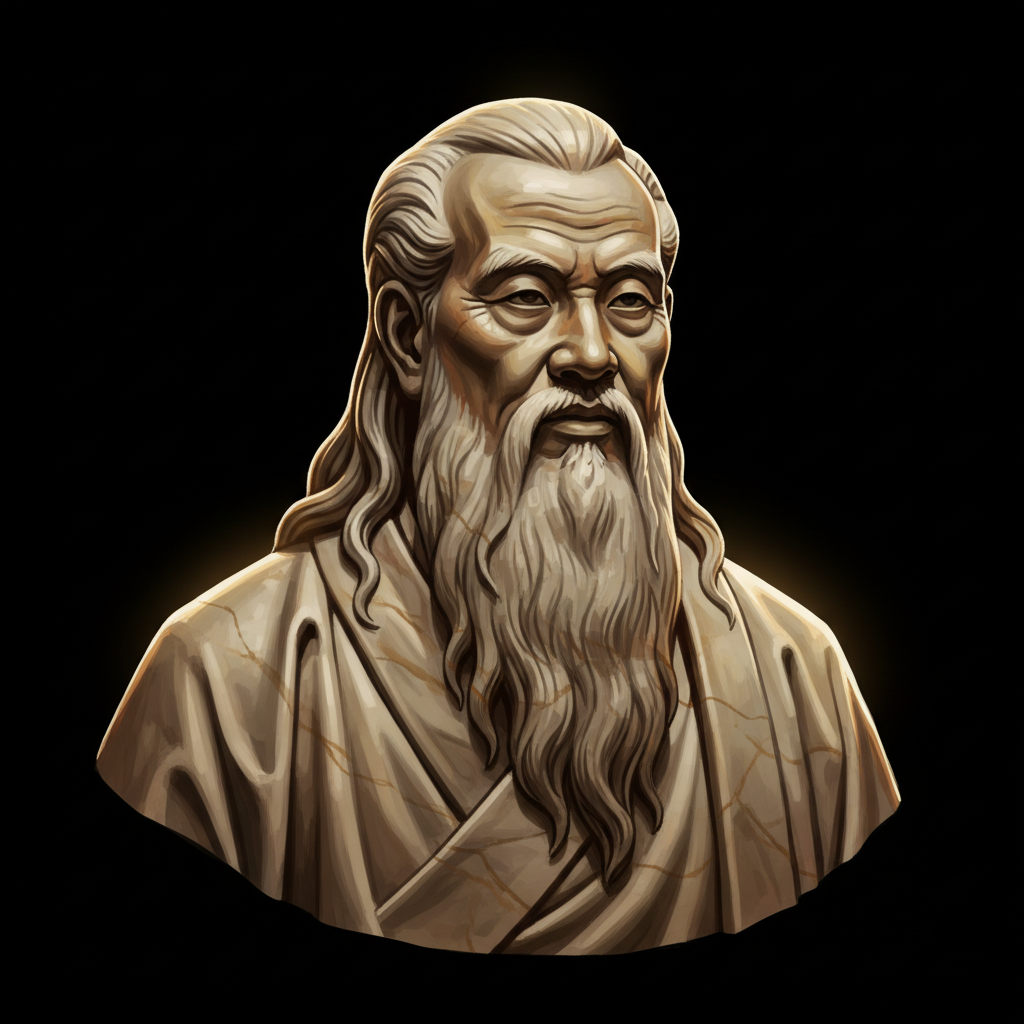
Laozi — "He who is content with what he has, is rich."
He who is content with what he has, is rich.
He who is content with what he has, is rich.
Click any product to generate a realistic preview. Up to 3 at a time.
* Initial load can take up to 90 seconds — revising the preview in another color is nearly instant.
"When the world has the Tao, the swift horses are used for hauling manure. When the world is without the Tao, war horses are bred in the suburbs."
"He who knows others is wise; he who knows himself is enlightened. He who conquers others is strong; he who conquers himself is mighty. He who is content is rich. He who acts with vigor has a will. He …"
"Time is a created thing. To say 'I don't have time' is to say 'I don't want to.'"
"The sage is sharp but not cutting, pointed but not piercing, straightforward but not unrestrained, brilliant but not dazzling."
"The best way to manage is to manage very little."
Reputed founder of Taoism and author of the Tao Te Ching, whose wu wei (effortless action) shaped East Asian philosophy. Closely associated with Zhuangzi (later Taoist who extended Laozi's framework). For an intellectual contrast, see Confucius, near-contemporary Chinese sage of social ritual and duty — Confucius systematized social order through ritual and hierarchy; Laozi argued that all such systems were the disease, not the cure — the two founding poles of Chinese moral philosophy.
Found in 1 providers: grok
1 source checked
True wealth comes from inner satisfaction rather than material accumulation. Someone who accepts and appreciates their current circumstances possesses genuine richness, regardless of their bank account or possessions. Constantly chasing more breeds poverty of spirit, since no amount ever feels sufficient. The person who recognizes sufficiency in what they already have escapes the endless treadmill of desire, finding abundance in perspective rather than acquisition. Contentment itself is the wealth worth pursuing.
Laozi, traditionally regarded as a sixth-century BCE sage and archivist in the Zhou court, championed wu wei (effortless action) and simplicity as paths to harmony with the Tao. Legend says he grew disillusioned with worldly ambition, left civilization on a water buffalo, and composed the Tao Te Ching at a border pass. This saying embodies his rejection of striving, status, and accumulation in favor of quiet self-sufficiency aligned with nature's rhythms.
Laozi lived during the late Zhou dynasty, an era of political fragmentation preceding the Warring States period. Feudal lords competed ruthlessly for territory, wealth, and prestige, while common people suffered under heavy taxation, conscription, and warfare. Confucian scholars promoted rigid social hierarchy and ritual ambition as remedies. Against this backdrop of relentless striving and militarized greed, Laozi's counsel toward contentment offered radical counter-philosophy: retreat from competition, embrace simplicity, and find peace outside the churning grasp of power.
AI-generated insights based on extensive research and information for context. Factual errors? Email [email protected].
Your cart is empty