Dalai Lama (14th) — "I think the Chinese government is a little bit like a child. Sometimes they beha…"
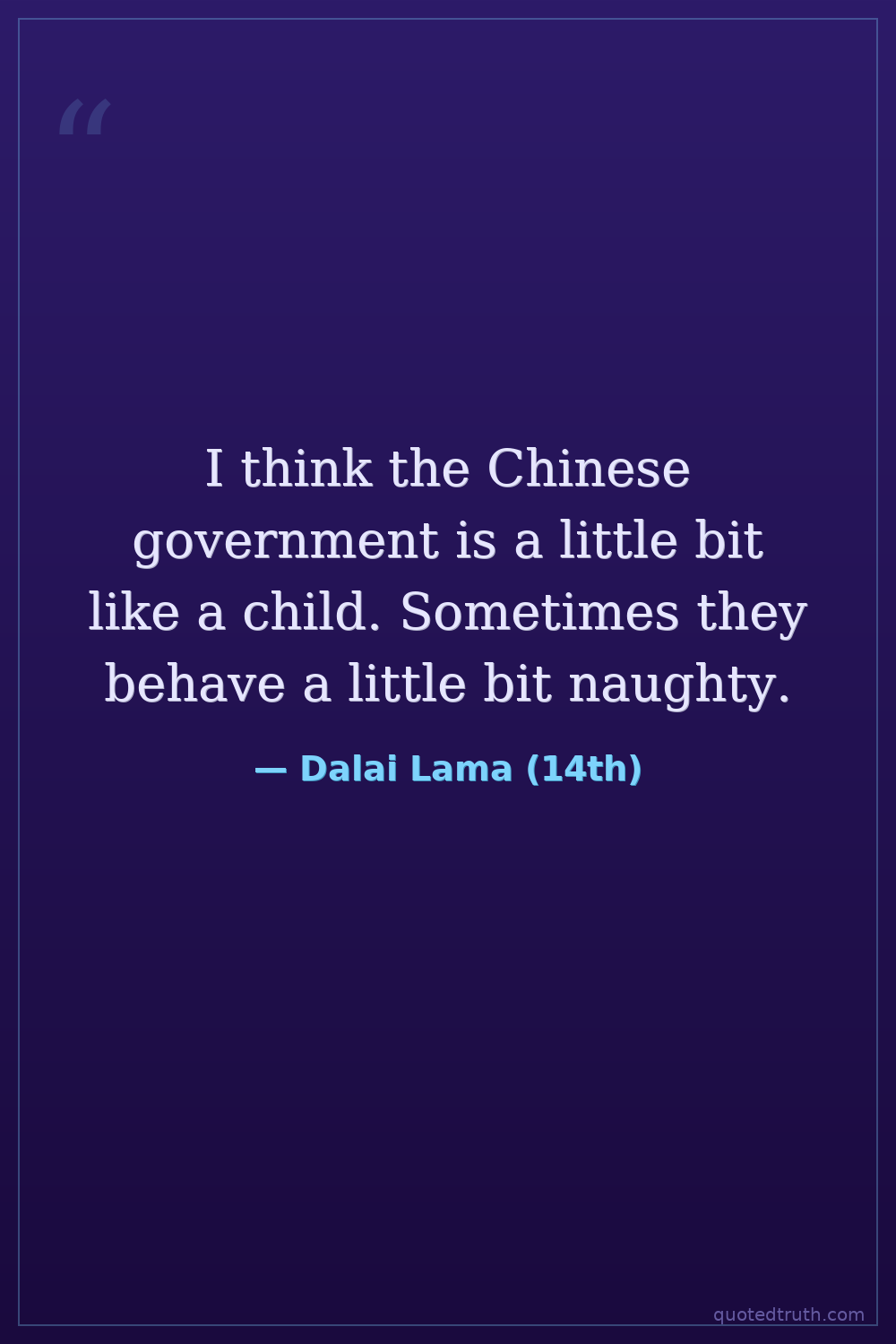
I think the Chinese government is a little bit like a child. Sometimes they behave a little bit naughty.
I think the Chinese government is a little bit like a child. Sometimes they behave a little bit naughty.
Click any product to generate a realistic preview. Up to 3 at a time.
* Initial load can take up to 90 seconds — revising the preview in another color is nearly instant.
"My father was a farmer, my mother was a farmer. My family was very poor."
"If scientific analysis were conclusively to demonstrate certain claims in Buddhism to be false, then we must accept the findings of science and abandon those claims."
"I think the most important thing is to be kind to others. That is the true meaning of happiness."
"I am an old man, but I still have a lot of energy. I think it's because I have a lot of hope."
"Happiness is not something ready-made. It comes from your own actions."
Found in 1 providers: grok
1 source checked
The Dalai Lama uses deliberately gentle, childlike language to criticize the Chinese government without escalating hostility. By comparing their behavior to a naughty child, he frames the conflict as immature conduct that can be corrected rather than fundamental evil. It is a diplomatic jab — pointed yet disarming — suggesting the government lacks wisdom rather than labeling them enemies, while still clearly disapproving of their conduct toward Tibet and its people.
Tenzin Gyatso fled Tibet in 1959 after China's military occupation and has spent over six decades in exile pursuing his nonviolent Middle Way approach, seeking genuine autonomy rather than full independence through dialogue. He consistently refuses to demonize China or call for armed resistance. His trademark warmth and humor shape even sharp political commentary. This quote reflects his core philosophy: maintain moral high ground, critique without hatred, and treat adversaries as capable of growth rather than irredeemable enemies.
Since China's annexation of Tibet in 1950 and the 1959 uprising forcing his exile, China grew into a global superpower while tightening control over Tibetan culture, language, and religion. The 2008 pre-Olympics protests, the 2010s self-immolation crisis, and Beijing's patriotic education campaigns intensified international scrutiny. Western nations increasingly balanced lucrative trade ties with China against human rights concerns, giving the Dalai Lama's carefully measured, non-inflammatory critiques significant diplomatic weight on the world stage.
AI-generated insights based on extensive research and information for context. Factual errors? Email [email protected].
Your cart is empty