What it means
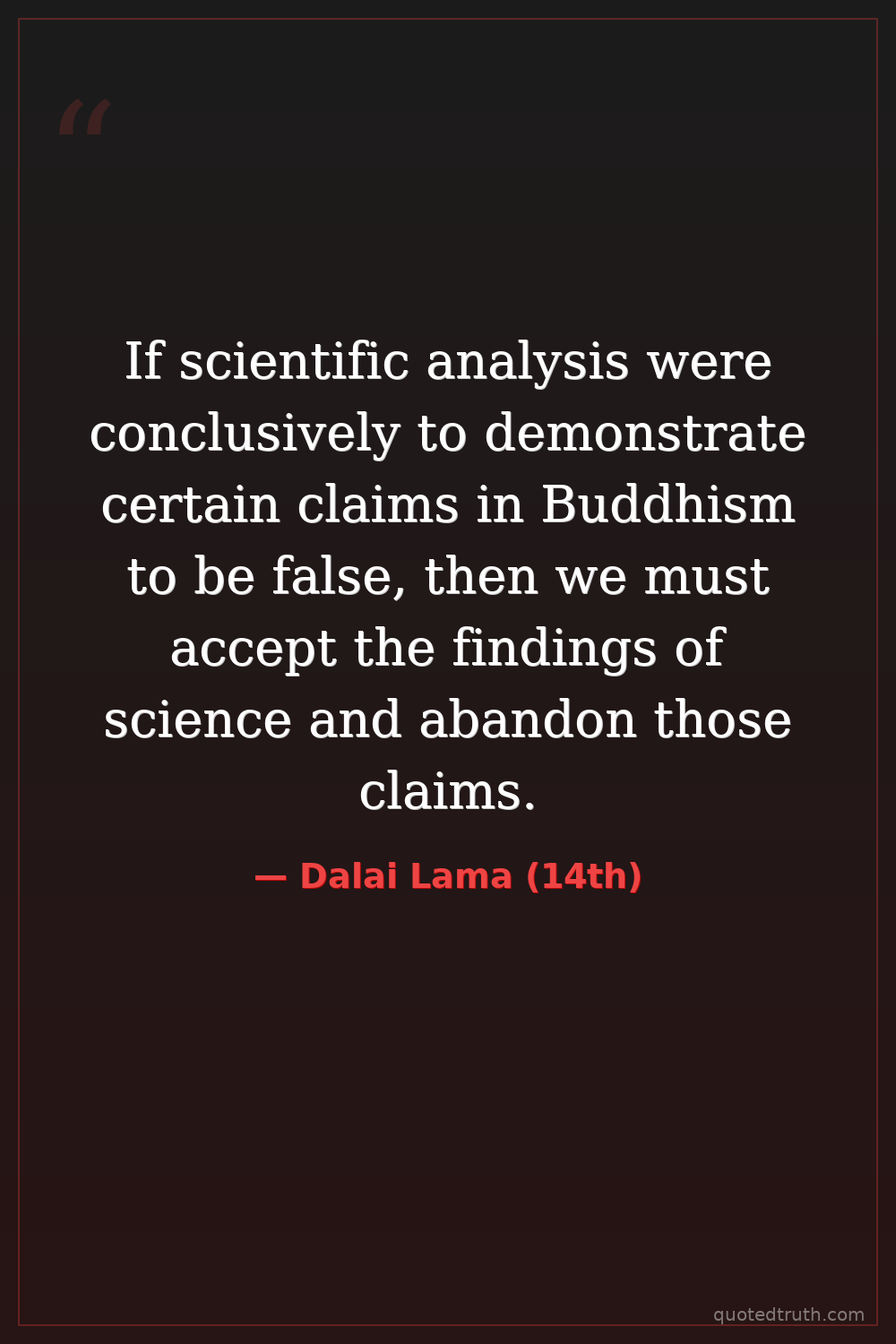
Truth-seeking must take priority over preserving inherited doctrine. When verifiable evidence conclusively contradicts a belief, intellectual honesty requires updating or abandoning that belief rather than defending it out of tradition or loyalty. No system of ideas — however ancient or revered — is exempt from correction by evidence. Genuine understanding matters more than institutional consistency. This is a statement of radical epistemic humility rare among leaders of major world religions.
Relevance to Dalai Lama (14th)
Tenzin Gyatso has spent decades in structured dialogue with scientists through the Mind & Life Institute, which he helped establish in 1987. His Buddhist training itself emphasizes rigorous investigation of the mind over blind faith. He has engaged neuroscientists studying meditation, physicists, and cognitive researchers, treating empirical findings as complementary to contemplative practice. This quote reflects his consistent position: Buddhism is a path of inquiry, and honest investigation — not institutional defensiveness — defines genuine wisdom.
The era
The Dalai Lama articulated this during a period of sharp global tension between science and religion — creationism battles, New Atheist critiques from Dawkins and Hitchens, and post-9/11 scrutiny of religious rigidity. Simultaneously, neuroscientists were measuring meditation's effects on the brain for the first time, validating contemplative practices empirically. His statement directly countered the defensive posture many religious institutions adopted, positioning Buddhism as uniquely willing to evolve under scientific pressure.
AI-generated insights based on extensive research and information for context. Factual errors? Email [email protected].