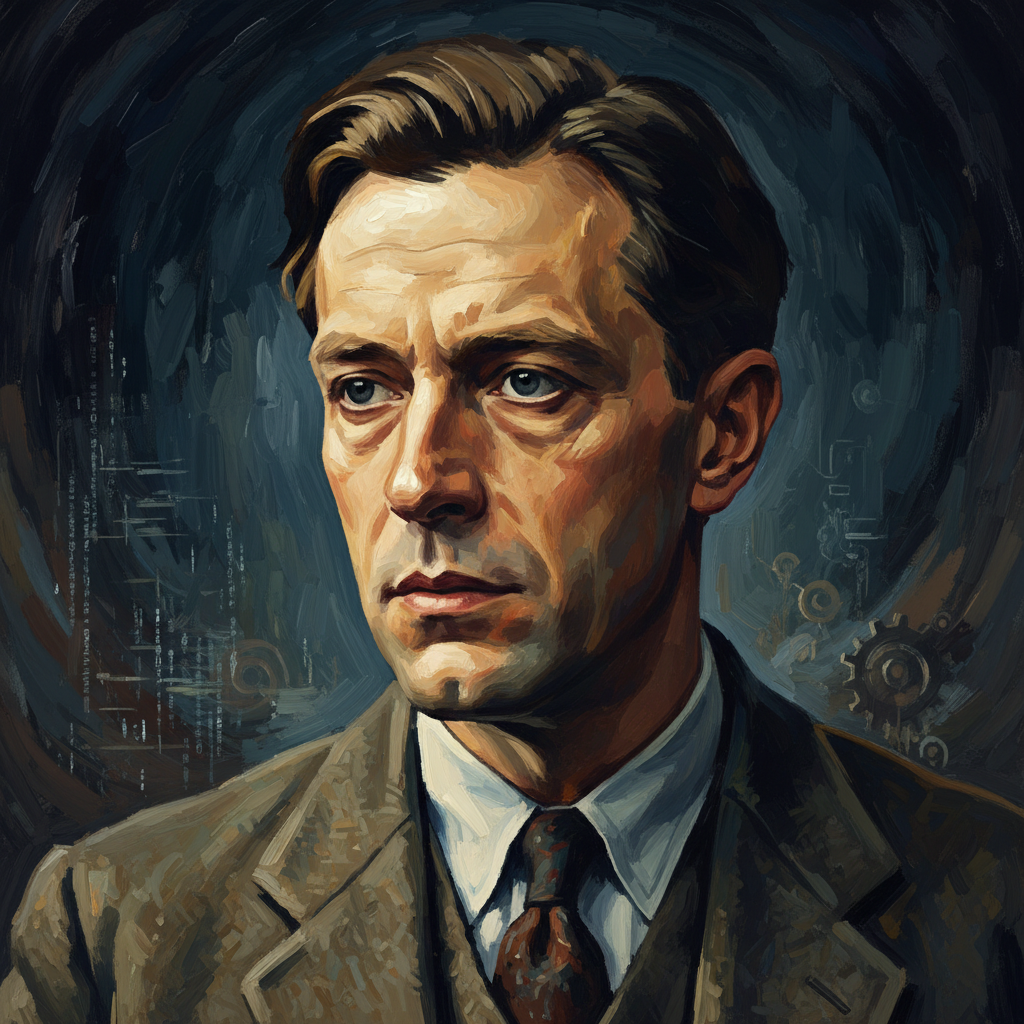
Alan Turing — "The original question, 'Can machines think?' I believe to be too meaningless to …"
The original question, 'Can machines think?' I believe to be too meaningless to deserve discussion.
The original question, 'Can machines think?' I believe to be too meaningless to deserve discussion.
Click any product to generate a realistic preview. Up to 3 at a time.
* Initial load can take up to 90 seconds — revising the preview in another color is nearly instant.
"I am not a believer in the idea that the human mind is something supernatural."
"The machine should be able to carry out logical deductions."
"The future belongs to those who believe in the beauty of their dreams."
"We are trying to make a brain."
"The computer is the most powerful tool ever invented by man."
Found in 3 providers: gemini,grok,deepseek
3 sources checked
Turing dismisses the question of machine intelligence as philosophically confused rather than answering it directly. Instead of debating an ill-defined concept like 'thinking,' he proposes replacing it with a concrete, testable criterion: the Imitation Game. If a machine can fool a human interrogator into believing it's human, the question of whether it truly 'thinks' becomes irrelevant. Precision in framing questions matters more than debating vague abstractions.
Turing spent his career translating abstract problems into precise, computable formulations — from breaking Enigma ciphers at Bletchley Park to defining computability itself. His 1950 paper 'Computing Machinery and Intelligence' exemplifies this instinct: rather than philosophizing, he operationalized the question. His life was defined by rigorous pragmatism, cutting through conceptual noise to find what could actually be measured, built, and solved.
In 1950, computers were room-sized machines performing basic arithmetic, yet Cold War pressure accelerated their development rapidly. Philosophers and scientists fiercely debated whether machines could ever truly reason. Turing's era saw the birth of cybernetics and information theory — disciplines forcing humanity to reconsider consciousness and intelligence. His reframing arrived precisely when society needed clearer thinking about what humanity's new computational tools actually were and could become.
AI-generated insights based on extensive research and information for context. Factual errors? Email [email protected].
Your cart is empty