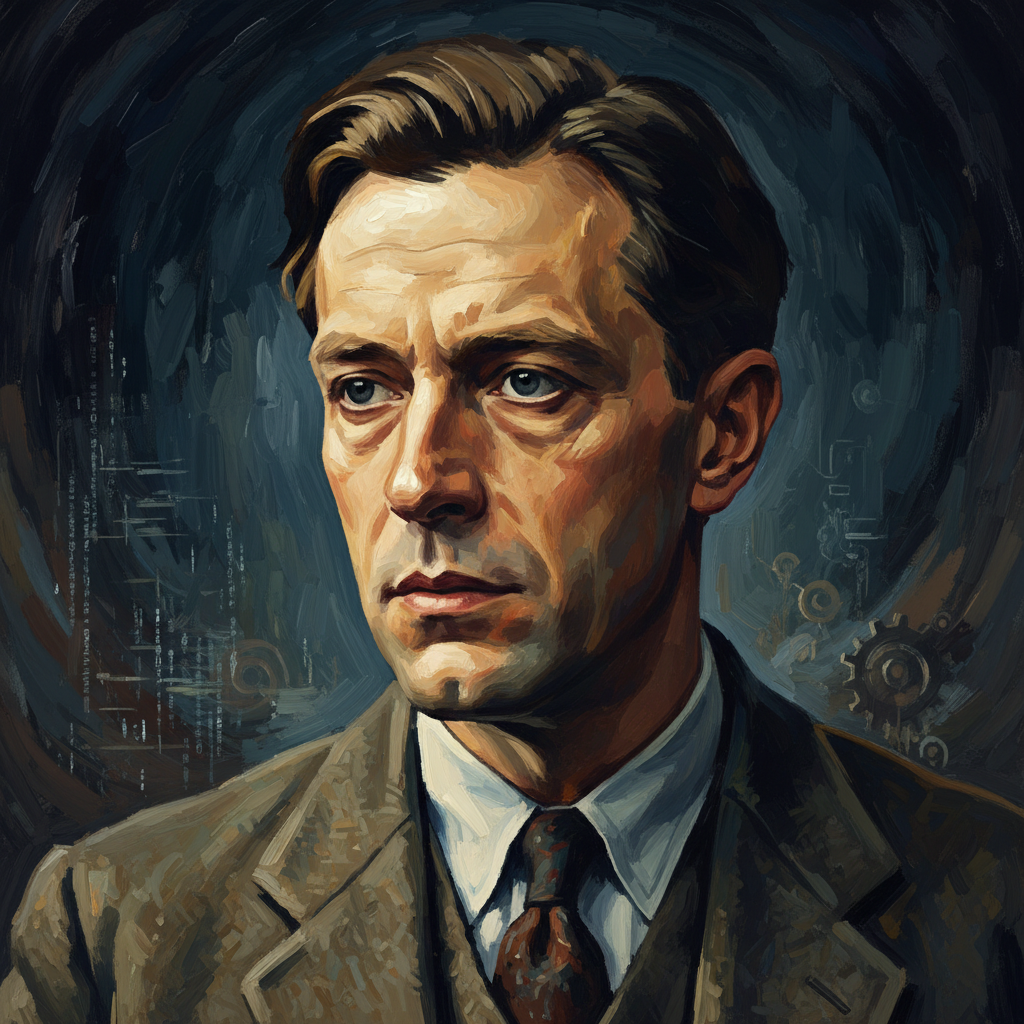
Alan Turing — "We are trying to make a brain."
We are trying to make a brain.
We are trying to make a brain.
Click any product to generate a realistic preview. Up to 3 at a time.
* Initial load can take up to 90 seconds — revising the preview in another color is nearly instant.
"It is not possible to produce a machine which will be intelligent in the same way that a human being is intelligent."
"The main problem with artificial intelligence is that it is too easy to make a machine that can do what we want it to do, but too hard to make a machine that can do what we don't want it to do."
"Programming is a skill best acquired by practice and example rather than from books."
"If it is accepted that real brains, as found in animals, and in particular in men, are a sort of machine it will follow that our digital computer suitably programmed, will behave like a brain..."
"The human brain is a machine, and it can be simulated by another machine."
Found in 1 providers: grok
1 source checked
The goal is building a machine that genuinely thinks, not just computes. It challenges the assumption that intelligence is uniquely biological, asserting instead that cognition can be engineered. The statement collapses centuries of philosophical debate into a practical engineering ambition: if we understand what thinking is, we can build it. It is both a scientific hypothesis and a declaration of intent — the foundational thesis of artificial intelligence.
Turing spent his career arguing that intelligence is process, not biology. His 1950 paper 'Computing Machinery and Intelligence' proposed the Turing Test, framing machine thought as a legitimate scientific question. At Manchester, he worked on the first stored-program computers with an explicit goal of machine cognition, not mere arithmetic. Prosecuted and chemically castrated by the British government for homosexuality in 1952, he pursued this vision despite systematic personal destruction.
In the late 1940s, the first general-purpose computers were months old and occupied entire rooms. The Cold War made machine intelligence a strategic priority. Norbert Wiener's cybernetics movement was asking whether machines and brains operate on the same principles. Society simultaneously feared and marveled at computing's potential. Turing's framing — 'a brain,' not 'a calculator' — was radical, redirecting an entire field from number-crunching toward the goal of thought itself.
AI-generated insights based on extensive research and information for context. Factual errors? Email [email protected].
Your cart is empty