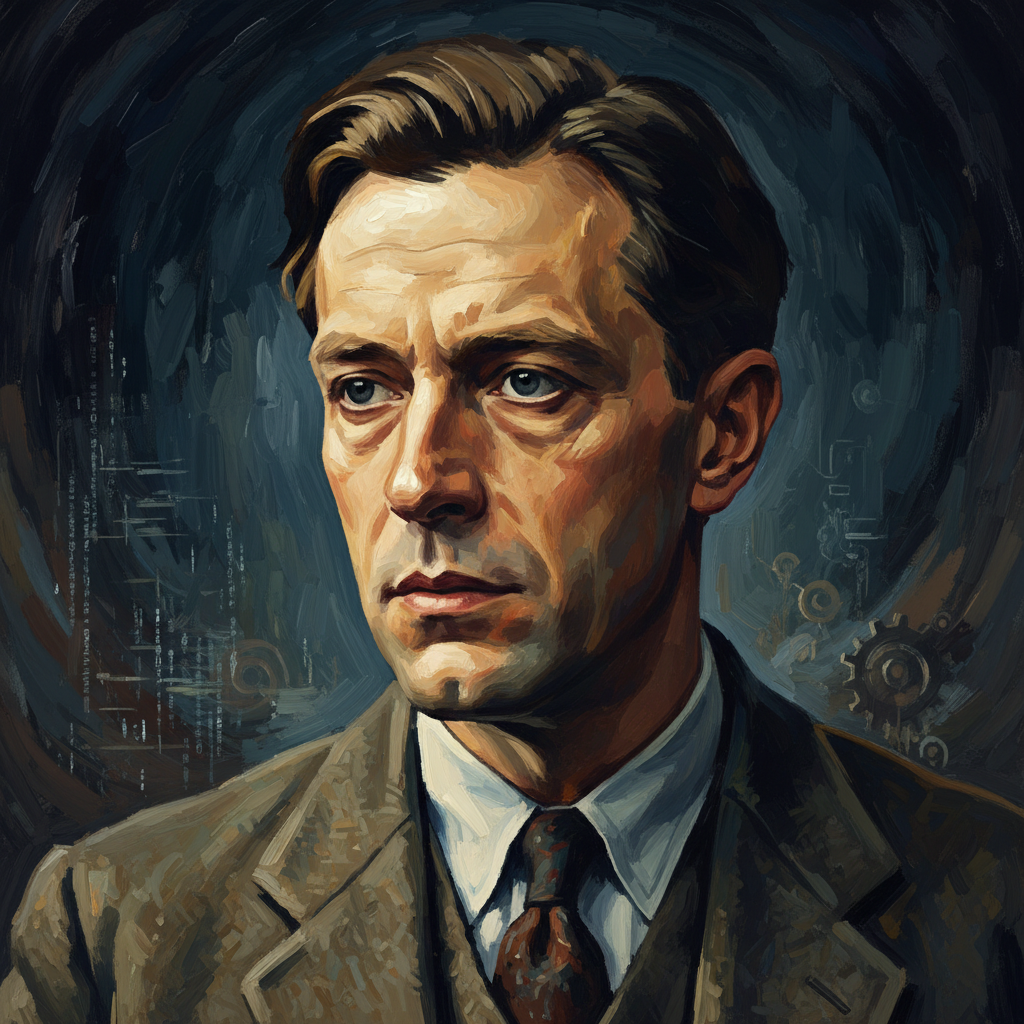
Alan Turing — "We are not interested in the fact that the brain has the consistency of cold por…"
We are not interested in the fact that the brain has the consistency of cold porridge.
We are not interested in the fact that the brain has the consistency of cold porridge.
Click any product to generate a realistic preview. Up to 3 at a time.
* Initial load can take up to 90 seconds — revising the preview in another color is nearly instant.
"This is only a foretaste of what is to come, and only the shadow of what is going to be."
"I don't think that human beings are the be-all and end-all of creation."
"The only real valuable thing is intuition."
"The popular view is that the brain is a kind of telephone exchange. I believe that it is not quite as simple as that."
"I have had a number of conversations with people who are convinced that machines cannot think. I have not been convinced by their arguments."
Found in 1 providers: gemini
1 source checked
The physical substance of the brain is irrelevant to understanding intelligence. What matters is how information is organized and processed, not whether it runs on neurons or transistors. Turing argues that mind is substrate-independent: a machine that reasons correctly is reasoning, regardless of construction. The squishy reality of biological tissue tells us nothing useful about the nature of thought itself.
Turing's career was built on abstraction — reducing computation to pure logical essence via the theoretical Turing machine. His 1950 paper 'Computing Machinery and Intelligence' proposed judging machine thought by behavior alone, not physical construction. Turing was prosecuted and chemically castrated by the British government for his homosexuality — a man literally persecuted for his biology. His dismissal of physical substrate carries unmistakable personal weight.
In the early 1950s, the first electronic computers existed but were considered glorified calculators. The brain was assumed biologically unique — no machine could truly think. Neuroscience was primitive; the physical brain was mysterious and sacrosanct. Turing's quote directly challenged this biological exceptionalism. Simultaneously, the Cold War accelerated military and academic investment in machine intelligence, making the question of what separated human thought from computation newly urgent and politically charged.
AI-generated insights based on extensive research and information for context. Factual errors? Email [email protected].
Your cart is empty