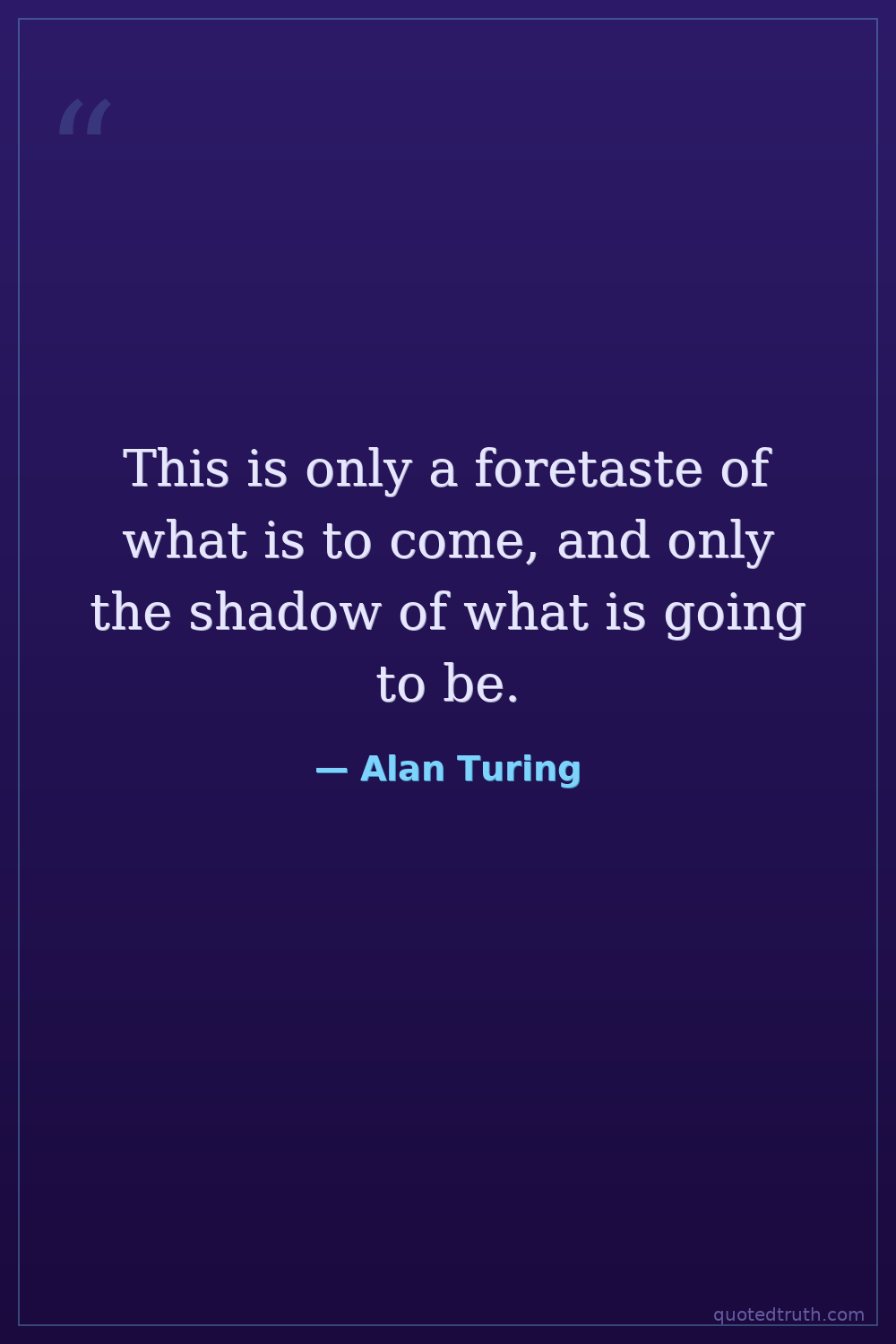
Alan Turing — "This is only a foretaste of what is to come, and only the shadow of what is goin…"
This is only a foretaste of what is to come, and only the shadow of what is going to be.
This is only a foretaste of what is to come, and only the shadow of what is going to be.
Click any product to generate a realistic preview. Up to 3 at a time.
* Initial load can take up to 90 seconds — revising the preview in another color is nearly instant.
"I am not afraid of computers. I am afraid of the people who program them."
"The possibility of a machine thinking is a disturbing thought for many people."
"No, I'm not interested in developing a powerful brain. All I'm after is just a mediocre brain, something like the President of the American Telephone and Telegraph Company."
"Science without religion is lame, religion without science is blind."
"We are trying to create a machine that can solve problems."
From an interview with The Times newspaper, talking about the potential of an early computing machine.
Date: 1949
WisdomFound in 1 providers: gemini
1 source checked
What we're witnessing right now is only a small taste — a faint preview — of vastly more powerful things to come. The present moment, however impressive, is merely the shadow cast by a far greater future. The speaker urges against being satisfied or dazzled by current achievements; something immeasurably larger is approaching. Ambition and foresight matter more than celebrating today's milestones.
Turing spoke these words in 1949 about early stored-program computers at Manchester. He had invented the theoretical Turing machine in 1936, broken Nazi Enigma codes at Bletchley Park, and was about to publish his landmark paper on machine intelligence in 1950. He genuinely believed computers would one day think. This quote reflects his characteristic visionary certainty — never awed by the current prototype, only by what it implied about future machine minds.
In 1949, the first stored-program computers — Manchester Mark 1, EDSAC — were barely operational, filling entire rooms to perform arithmetic a child could do mentally. Most scientists viewed them as glorified calculators. The Cold War was intensifying interest in cryptography and computation. Against this backdrop, Turing's declaration that these machines were only a shadow of what was coming was radical; the dominant assumption was that computers were sophisticated tools, not precursors to artificial minds.
AI-generated insights based on extensive research and information for context. Factual errors? Email [email protected].
Your cart is empty