What it means
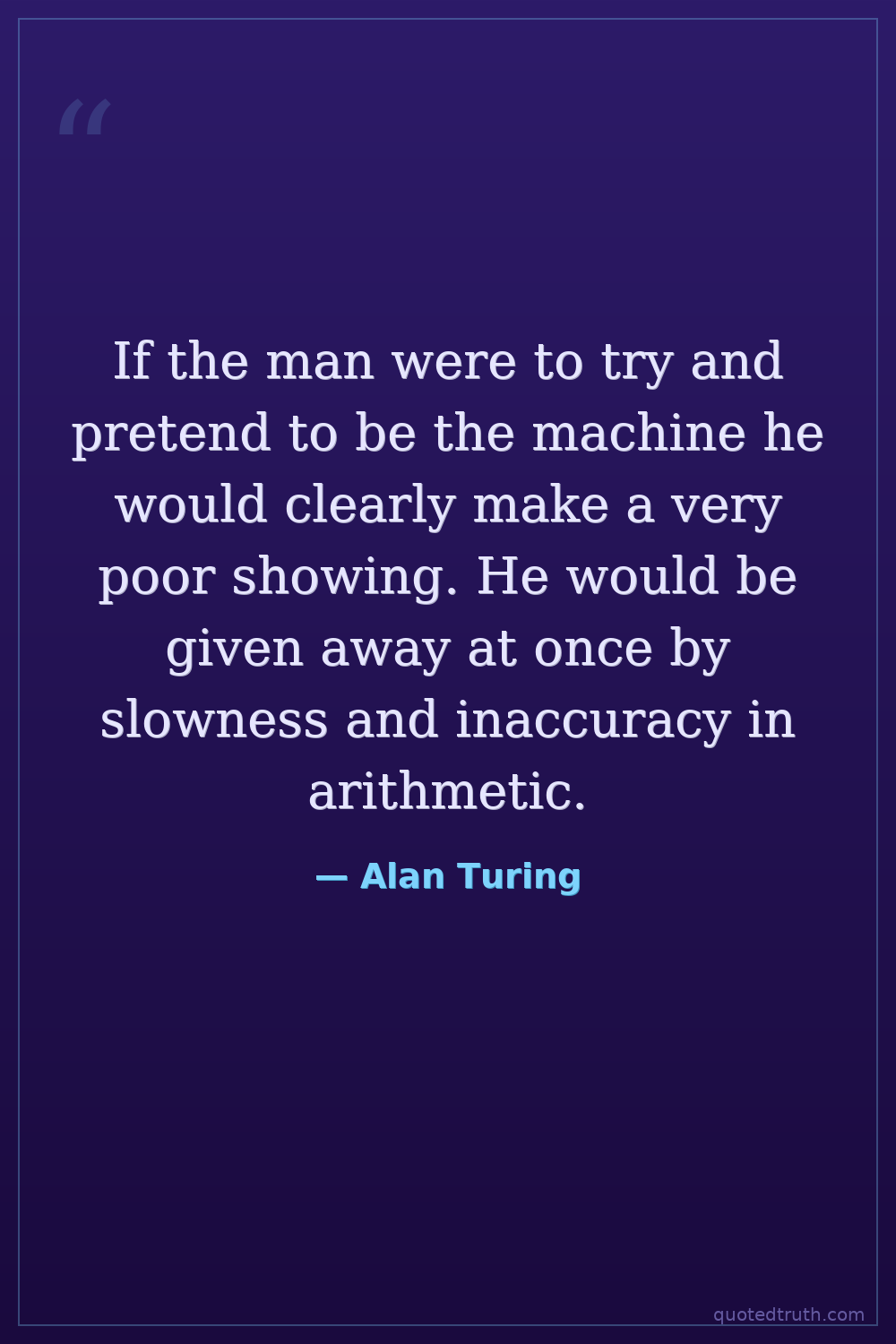
A human attempting to imitate a computer would fail immediately — humans are slow and error-prone at arithmetic compared to machines. The point is asymmetric: machines can plausibly mimic human thought patterns, but humans cannot plausibly mimic machine precision. This asymmetry is what makes the imitation game interesting and meaningful as a test of machine intelligence.
Relevance to Alan Turing
Turing spent WWII breaking Enigma ciphers at Bletchley Park, directly experiencing the gap between human and mechanical computation. His 1950 paper proposing the Turing Test was built on this asymmetry — he designed the test specifically so a machine imitates a human, not vice versa, because he understood from hands-on experience exactly where each party's limitations lay.
The era
In 1950, electronic computers were room-sized novelties performing calculations humans had done by hand for centuries. The cultural anxiety ran the other way — could machines think like us? Turing inverted the question brilliantly, noting machines already surpassed humans at arithmetic, making the reverse imitation trivially easy to defeat and therefore uninteresting as a test.
AI-generated insights based on extensive research and information for context. Factual errors? Email [email protected].