Alan Turing — "The extent to which we regard mind as distinct from matter, is a matter of conve…"
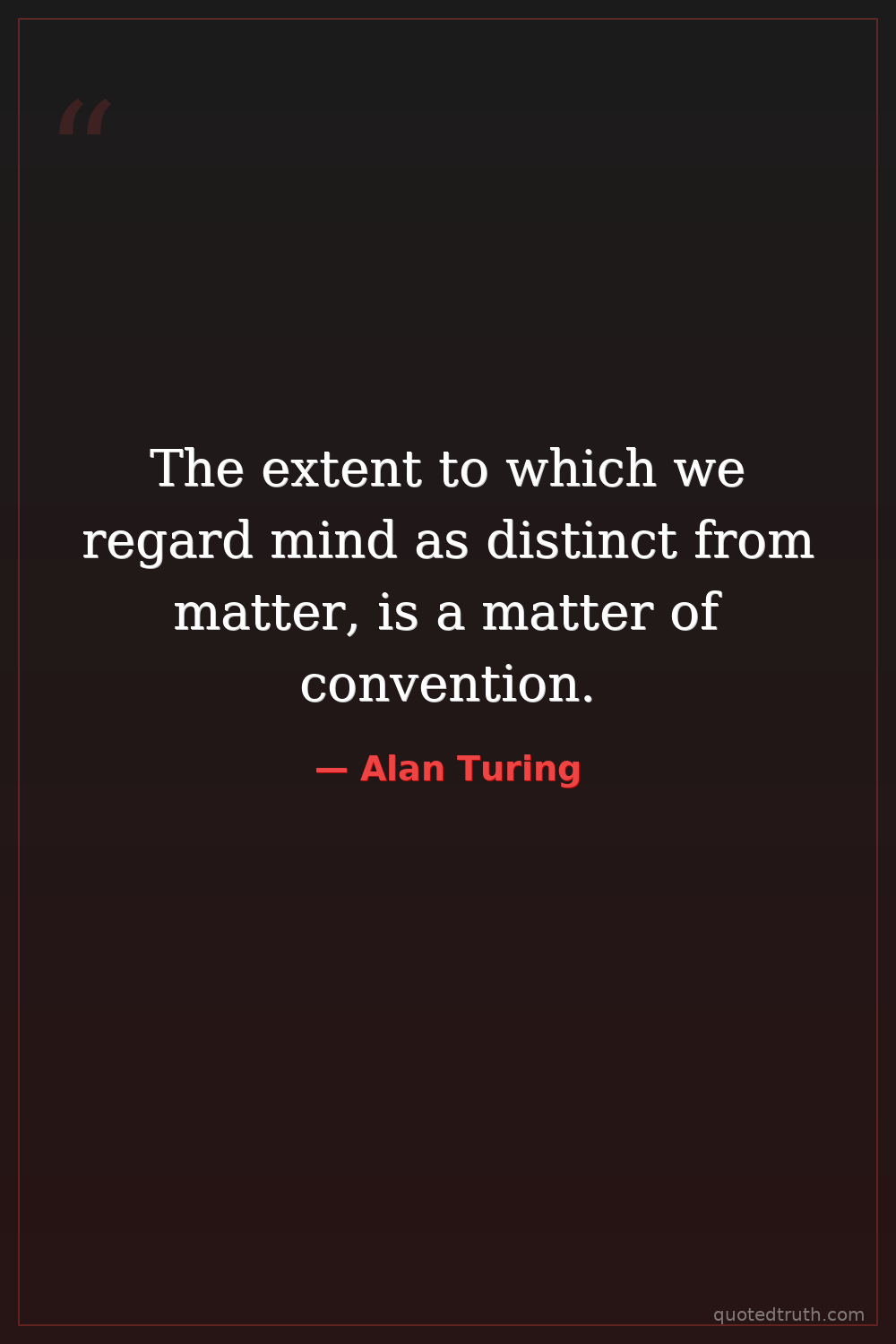
The extent to which we regard mind as distinct from matter, is a matter of convention.
The extent to which we regard mind as distinct from matter, is a matter of convention.
Click any product to generate a realistic preview. Up to 3 at a time.
* Initial load can take up to 90 seconds — revising the preview in another color is nearly instant.
"The only real valuable thing is intuition."
"The new form of the problem can be described in terms of a game which we call the 'imitation game.' It is played with three people, a man (A), a woman (B), and an interrogator (C) who may be of either…"
"The human intellect is a very powerful thing, but it has its limitations."
"We are not interested in the fact that a machine can solve a problem, but in the fact that it can solve a problem that we cannot."
"The machine should be able to learn from experience."
Found in 1 providers: grok
1 source checked
The sharp divide we draw between mind and physical matter isn't a fixed truth of nature—it's a convention, a chosen framework. We decide to treat consciousness as fundamentally different from brain tissue, but that decision is pragmatic, not necessary. The boundary could be redrawn. This rejects hard dualism and opens the door to treating thought as a physical, computable process—no mystical substance required, just a useful distinction we've agreed to observe.
Turing's 1950 paper introducing the Turing Test deliberately avoided defining consciousness, asking instead whether a machine's behavior was indistinguishable from a human's—the pragmatic move this quote predicts. If mind-matter distinction is conventional, define thinking behaviorally, not metaphysically. Turing believed computation was a form of thought: his theoretical machines processed symbols by mechanical rules, collapsing the boundary. His codebreaking at Bletchley further showed that pure logical process could crack what human minds produced.
Writing in the late 1940s and early 1950s, Turing worked amid the birth of digital computing and Norbert Wiener's cybernetics movement, which reframed minds as information systems. Logical positivism was pushing philosophy away from metaphysics toward the observable and measurable. The first programmable computers—Colossus, ENIAC, Manchester Baby—forced genuine questions about machine intelligence for the first time. Culturally, humanity's claim to unique spiritual status felt newly fragile after the industrialized horror of World War II.
AI-generated insights based on extensive research and information for context. Factual errors? Email [email protected].
Your cart is empty