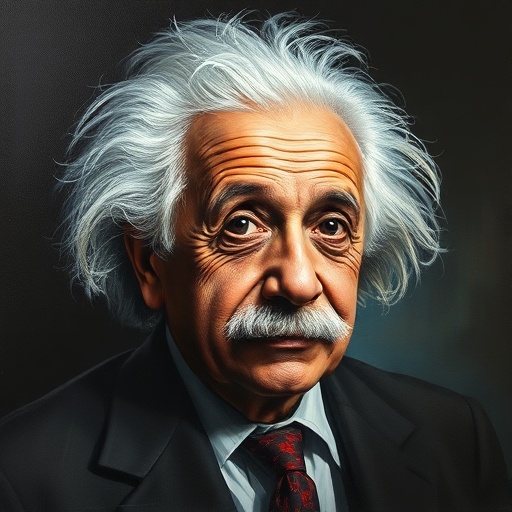
Albert Einstein — "The only thing that interferes with my learning is my education."
The only thing that interferes with my learning is my education.
The only thing that interferes with my learning is my education.
Click any product to generate a realistic preview. Up to 3 at a time.
* Initial load can take up to 90 seconds — revising the preview in another color is nearly instant.
"Compound interest is the eighth wonder of the world. He who understands it, earns it... he who doesn't... pays it."
"The human spirit must prevail over technology."
"Science without religion is lame, religion without science is blind."
"The human mind has first to construct forms, independently, before we can find them in things."
"Technological progress is like an axe in the hands of a pathological criminal."
Attributed, but often paraphrased from 'My Credo'
Date: Undetermined, possibly 1954
EducationalFound in 1 providers: grok
1 source checked
Formal education, with its rigid structures, rote memorization, and demand for compliance, can actively suppress the curiosity and independent thinking that drive genuine intellectual growth. True learning springs from wonder and self-directed inquiry. The statement is a paradox: the very institution designed to cultivate knowledge becomes its biggest obstacle when it rewards conformity over questioning and grades over understanding.
Einstein famously clashed with authoritarian schooling at Munich's Luitpold Gymnasium and initially failed his ETH Zurich entrance exam. He developed special relativity while working as a patent clerk, entirely outside academia. He consistently championed imagination over memorization and questioned established authority throughout his career. His distrust of institutional constraints was not abstract — it shaped the unconventional thinking that overturned Newtonian physics entirely.
Einstein came of age in late 19th-century Germany and Switzerland, where education systems were rigidly hierarchical, built on Prussian-model drilling and strict obedience to authority. The Industrial Revolution had reshaped schools into factories producing disciplined workers, not critical thinkers. Simultaneously, physics itself was in revolutionary upheaval — classical mechanics was crumbling — making institutional resistance to new ideas both visibly harmful and historically consequential during Einstein's formative years.
AI-generated insights based on extensive research and information for context. Factual errors? Email [email protected].
Your cart is empty