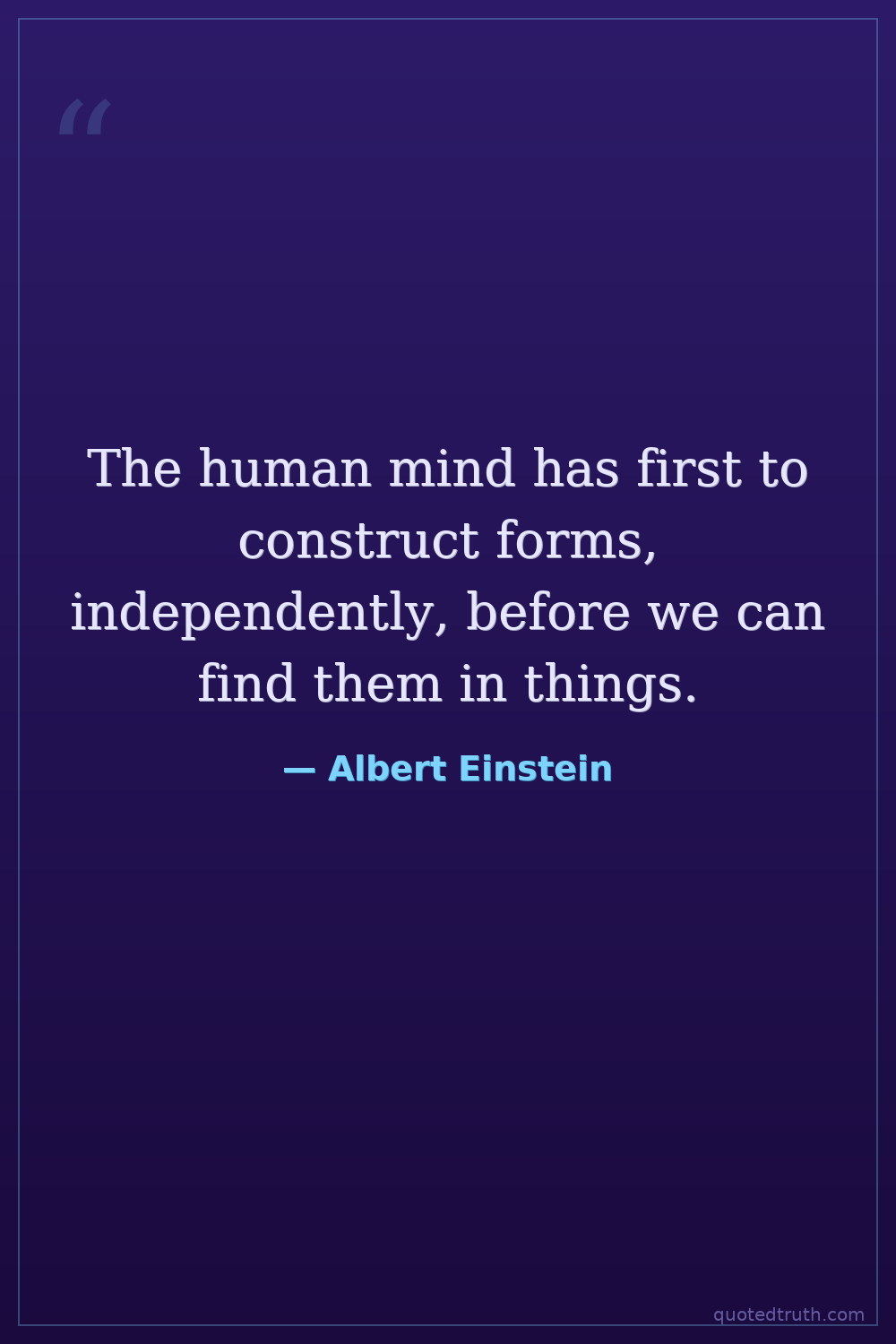
Albert Einstein — "The human mind has first to construct forms, independently, before we can find t…"
The human mind has first to construct forms, independently, before we can find them in things.
The human mind has first to construct forms, independently, before we can find them in things.
Click any product to generate a realistic preview. Up to 3 at a time.
* Initial load can take up to 90 seconds — revising the preview in another color is nearly instant.
"I am by heritage a Jew, by citizenship a Swiss, and by temperament a human being, and only a human being, without any special attachment to any state or national entity whatsoever."
"I am a deeply religious nonbeliever. This is a somewhat new kind of religion."
"The secret to creativity is knowing how to hide your sources."
"I believe in intuitions and inspirations. I sometimes feel that I am right. I do not know that I am."
"The pursuit of truth and beauty is a sphere of activity in which we are permitted to remain children all our lives."
Found in 1 providers: grok
1 source checked
Before we can recognize patterns or structures in the world around us, our minds must first build those mental frameworks independently. Understanding isn't passive reception of external reality—it's an active construction. We don't discover forms by looking outward; we first generate conceptual templates internally, then apply them to make sense of what we observe.
Einstein's theoretical work exemplified this principle directly. He developed general relativity not through laboratory experiments but through thought experiments and pure mathematical reasoning—constructing geometric frameworks for spacetime before observational confirmation arrived. His belief in the primacy of mathematical imagination over empirical data drove his lifelong insistence that physical intuition and creative mental construction precede discovery.
Einstein worked during the early 20th century, when quantum mechanics and relativity overturned Newtonian certainties. Philosophers like Kant had argued similarly that the mind imposes structure on experience. Einstein's era witnessed science moving from direct observation toward abstract mathematical modeling—a profound shift where human-constructed formalisms like tensor calculus became essential tools for understanding physical reality.
AI-generated insights based on extensive research and information for context. Factual errors? Email [email protected].
Your cart is empty