Charles Darwin — "I have called this principle, by which each slight variation, if useful, is pres…"
I have called this principle, by which each slight variation, if useful, is preserved, by the term Natural Selection.
I have called this principle, by which each slight variation, if useful, is preserved, by the term Natural Selection.
Click any product to generate a realistic preview. Up to 3 at a time.
* Initial load can take up to 90 seconds — revising the preview in another color is nearly instant.
"I am a strong believer in the power of observation and the importance of collecting facts."
"Man, with all his noble qualities, with sympathy which feels for the most debased, with benevolence which extends not only to other men but to the humblest living creature, with his god-like intellect…"
"I see no good reason why the views given in this volume should shock the religious feelings of any one."
"Blushing is the most peculiar and most human of all expressions."
"The highest possible stage in moral culture is when we recognize that we ought to control our thoughts."
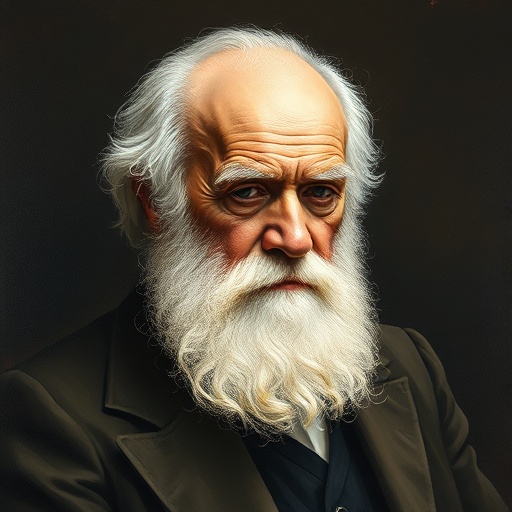
British naturalist whose On the Origin of Species (1859) established evolution by natural selection — the unifying theory of modern biology. Closely associated with Thomas Henry Huxley (his 'bulldog' public defender) and Alfred Russel Wallace (independent co-discoverer of natural selection). For an intellectual contrast, see William Paley, Anglican theologian and Natural Theology author (1743-1805) — Origin of Species is structurally a 400-page reply to Paley — Darwin admired Paley's watchmaker-argument as an undergraduate at Cambridge and then spent 20 years building the empirical machinery to displace him. The cleanest 'design argument vs natural selection' founding rebuttal in science.
The standard scholarly entry points to Charles Darwin's work: Janet Browne (Harvard, history of science) — Charles Darwin: Voyaging (1995) and The Power of Place (2002); Adrian Desmond (UCL, biographer) — Darwin: The Life of a Tormented Evolutionist (1991, with James Moore). These are the works graduate seminars cite when teaching Charles Darwin.
Found in 1 providers: grok
1 source checked
Each small, beneficial change in a living organism gets passed on because it helps survival and reproduction. Over generations, these tiny advantages accumulate, gradually transforming species. Darwin named this mechanism Natural Selection — nature itself acting as the selector, favoring traits that improve an organism's chances of surviving and leaving offspring, without any conscious intent or divine direction guiding the process.
Darwin spent over two decades refining this concept after his Beagle voyage observations. His meticulous breeding experiments with pigeons and barnacle studies gave him confidence to name and defend this mechanism. The careful phrasing — 'I have called this principle' — reflects his characteristic precision and ownership of an idea he knew would overturn centuries of fixed-species thinking.
Published in On the Origin of Species in 1859, this statement entered a world where natural theology dominated biology. Most educated Victorians believed species were divinely created and immutable. Darwin's naming of Natural Selection provided a materialist, testable mechanism for change that directly challenged religious orthodoxy, sparking fierce debate among clergy, scientists, and the public throughout the latter half of the 19th century.
AI-generated insights based on extensive research and information for context. Factual errors? Email [email protected].
Your cart is empty