What it means
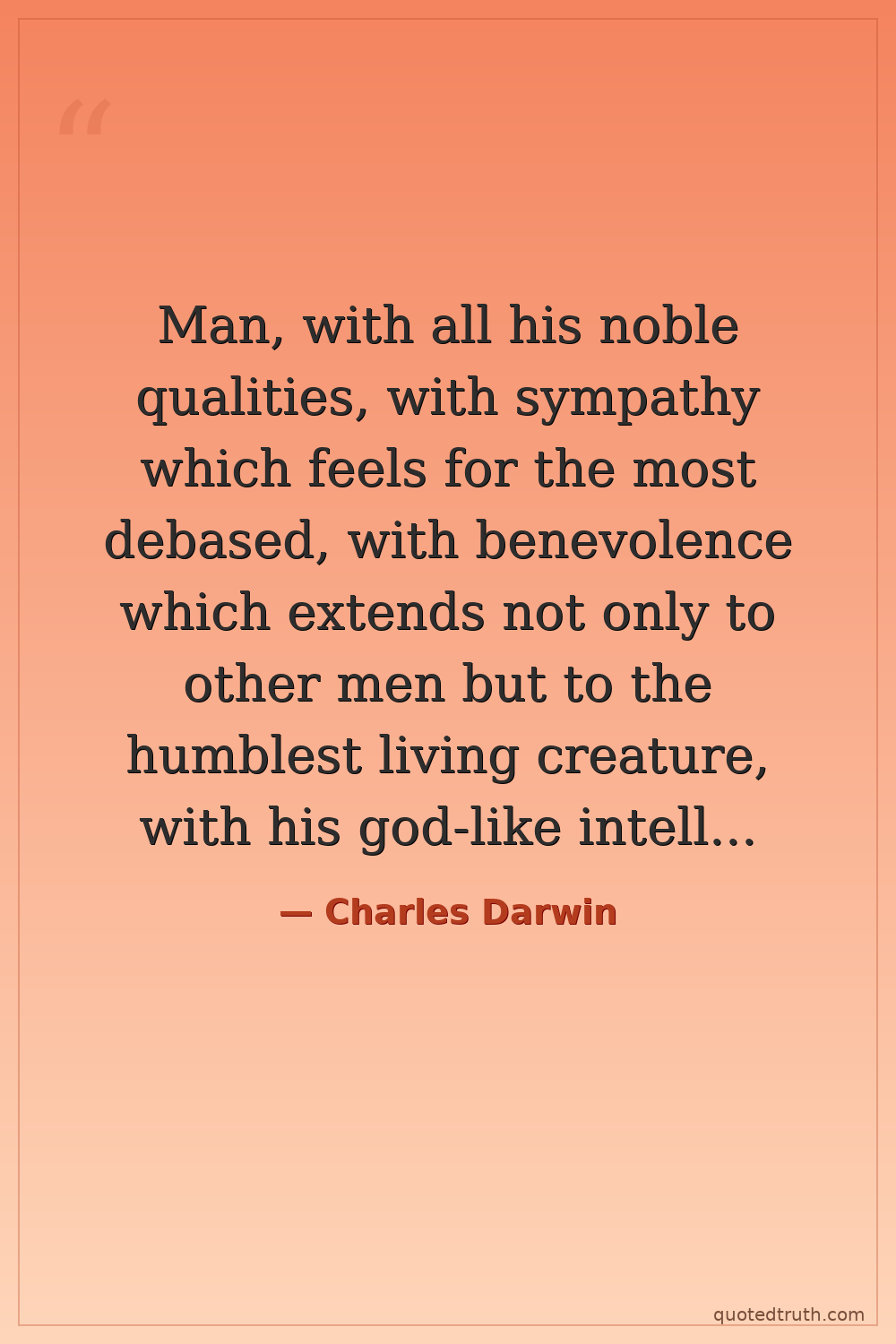
Humans possess extraordinary qualities — compassion that extends even to humble creatures, intellect capable of mapping the cosmos, deep moral sympathy. Yet despite all these remarkable traits, our physical bodies still carry undeniable evidence of primitive origins. No matter how elevated our minds and character become, our anatomy tells a humbler story: we descended from simpler life forms, and our flesh still shows it.
Relevance to Charles Darwin
Darwin spent decades building the case for evolution through natural selection, culminating in The Descent of Man (1871), where this passage closes the book. It captures his core conviction: humans are continuous with all life, not divinely separate from it. Darwin himself was known for genuine admiration of human capacities alongside scientific rigor — this quote reflects that tension he lived, celebrating humanity while insisting we accept our biological place in nature honestly.
The era
Victorian Britain held human exceptionalism as theological and social bedrock — humans were God's special creation, categorically distinct from animals. Darwin's Origin of Species (1859) had already fractured this assumption, but The Descent of Man (1871) brought the argument home explicitly. Religious leaders, philosophers, and the public fiercely resisted applying evolution to humanity. This sentence was a direct, deliberate challenge to that resistance, delivered at a moment when the idea felt genuinely destabilizing to civilization's self-image.
AI-generated insights based on extensive research and information for context. Factual errors? Email [email protected].