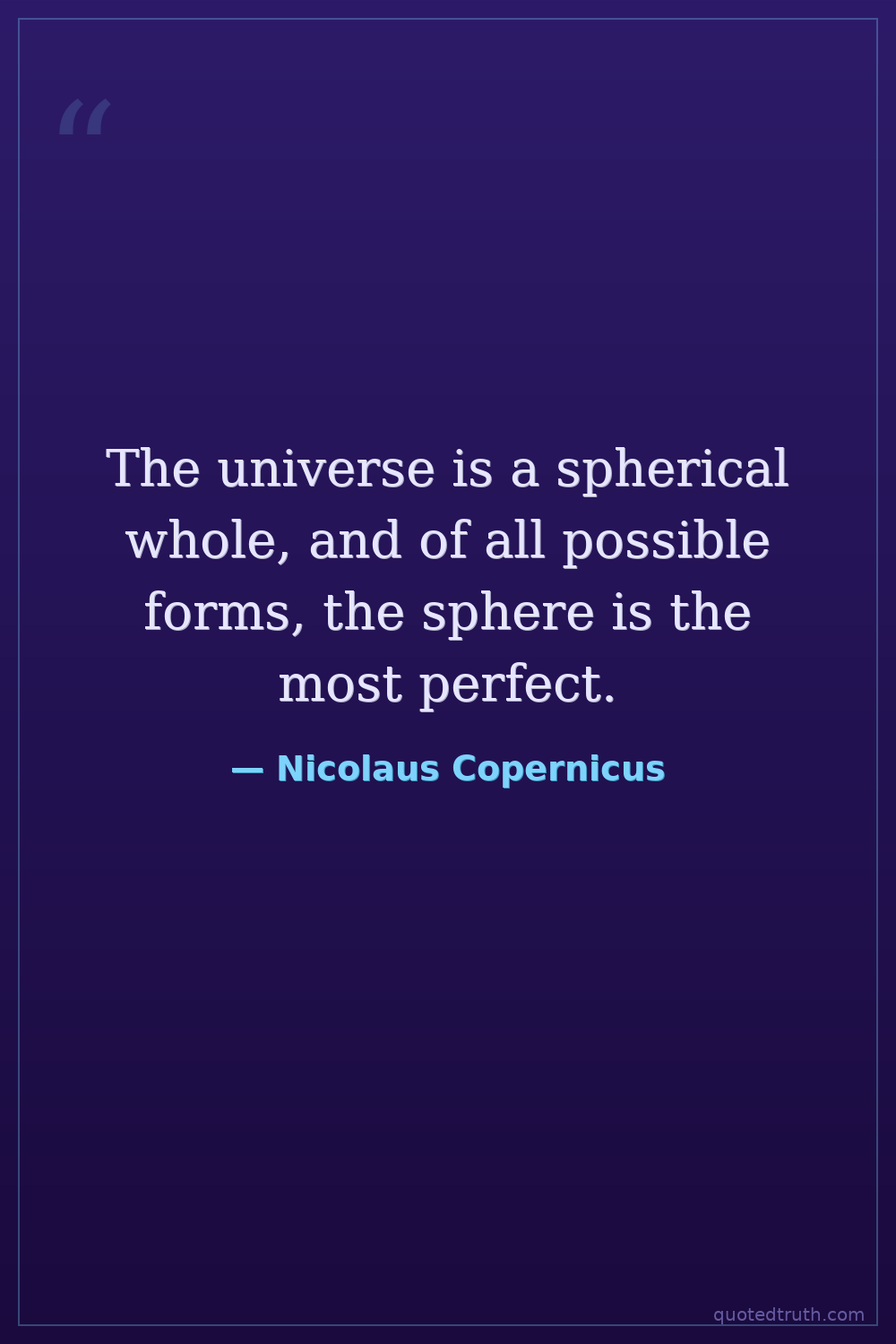
Nicolaus Copernicus — "The universe is a spherical whole, and of all possible forms, the sphere is the …"
The universe is a spherical whole, and of all possible forms, the sphere is the most perfect.
The universe is a spherical whole, and of all possible forms, the sphere is the most perfect.
Click any product to generate a realistic preview. Up to 3 at a time.
* Initial load can take up to 90 seconds — revising the preview in another color is nearly instant.
"The Sun is the center of the universe, and all the planets revolve around it."
"I consider it the chief duty of an astronomer to gather the observations of the heavenly bodies, and to explain their motions by hypotheses."
"For it is the duty of an astronomer to compose the history of the celestial motions from a careful and skillful study of the observations."
"To know the mighty works of God, to comprehend His wisdom and majesty and power; to appreciate, in degree, the wonderful workings of His laws, surely all this must be a pleasing and acceptable mode of…"
"The order of the planets is as follows: Saturn, Jupiter, Mars, Earth, Venus, Mercury, and in the middle of all, the Sun."
De revolutionibus orbium coelestium (concept, not a precise direct quote)
Date: 1543
InspirationalFound in 1 providers: grok
1 source checked
The universe takes the shape of a perfect sphere, and among all geometric forms, the sphere represents the highest ideal of completeness and harmony. This expresses a conviction that nature operates according to mathematical elegance and geometric perfection, that the cosmos is ordered and symmetrical rather than chaotic, and that understanding its shape reveals something fundamental about how reality is structured.
Copernicus built his heliocentric model partly on the ancient assumption that celestial bodies move in perfect circles and spheres. His 1543 work De Revolutionibus Orbium Coelestium placed the Sun at the center while preserving spherical planetary orbits. As a canon and mathematician steeped in Neoplatonic thought, he genuinely believed geometric perfection was evidence of divine craftsmanship embedded in astronomical structure.
During the early modern period, Renaissance thinkers revived classical Greek ideals linking geometric perfection to divine order. Aristotelian cosmology still dominated, teaching that celestial spheres carried planets around Earth. Copernicus worked within this tradition even while overturning it. The period saw intensifying interest in mathematics as the language of God's creation, making spherical perfection not merely aesthetic but theologically and philosophically foundational.
AI-generated insights based on extensive research and information for context. Factual errors? Email [email protected].
Your cart is empty