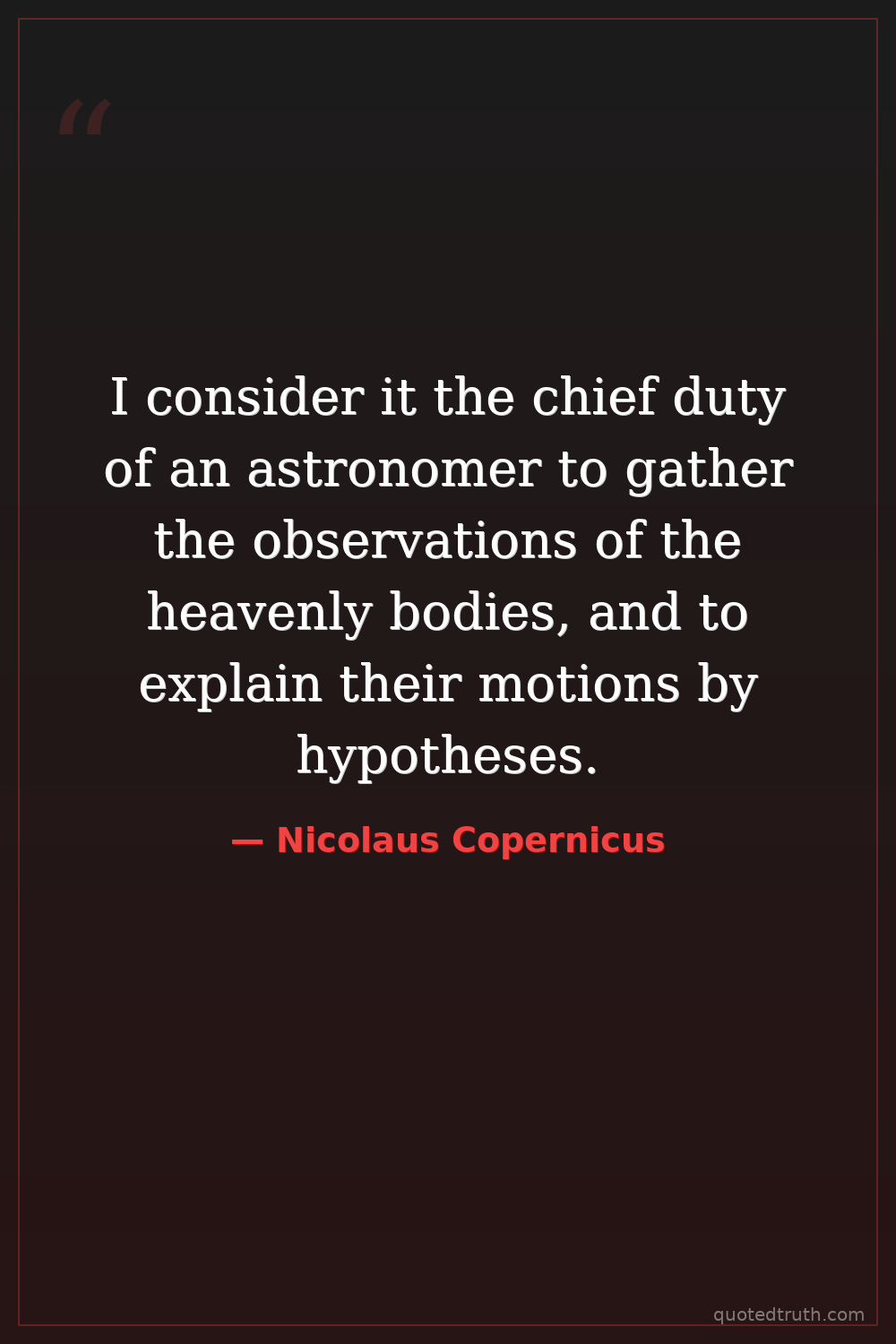
Nicolaus Copernicus — "I consider it the chief duty of an astronomer to gather the observations of the …"
I consider it the chief duty of an astronomer to gather the observations of the heavenly bodies, and to explain their motions by hypotheses.
I consider it the chief duty of an astronomer to gather the observations of the heavenly bodies, and to explain their motions by hypotheses.
Click any product to generate a realistic preview. Up to 3 at a time.
* Initial load can take up to 90 seconds — revising the preview in another color is nearly instant.
"The Sun, the Moon, and the Earth, are all parts of one great system."
"For it is manifest that the movements of the planets are not uniform, but sometimes faster, sometimes slower, sometimes direct, sometimes retrograde."
"The earth, too, has other motions than that of the daily rotation."
"Astronomy is written for astronomers."
"Finally we shall place the Sun himself at the center of the Universe."
Found in 1 providers: grok
1 source checked
An astronomer's primary job is twofold: carefully collect precise measurements of how celestial bodies move, then construct theoretical frameworks that logically account for those movements. Observation and explanation are inseparable partners. Data without theory is meaningless noise; theory without observational grounding is mere speculation. True astronomical science demands both rigorous empirical records and coherent mathematical models to make sense of the heavens.
Copernicus spent decades meticulously observing planetary positions before publishing his heliocentric theory in 1543. His magnum opus, De Revolutionibus, embodied exactly this principle: exhaustive observational tables paired with a revolutionary mathematical framework. He delayed publication for years to ensure his hypotheses genuinely explained the data. His entire career demonstrated that astronomical duty meant neither passive stargazing nor untethered theorizing, but their disciplined marriage.
In early 16th-century Europe, astronomy remained shackled to Ptolemaic geocentrism, a 1,400-year-old framework increasingly strained by accumulated observational discrepancies. The Church institutionalized cosmological authority, making theoretical revision dangerous. Renaissance humanism simultaneously encouraged returning to ancient sources and questioning received wisdom. Copernicus navigated this tension by framing heliocentrism as a better hypothesis rather than theological challenge, using the language of professional astronomical duty to legitimize radical cosmological reform.
AI-generated insights based on extensive research and information for context. Factual errors? Email [email protected].
Your cart is empty