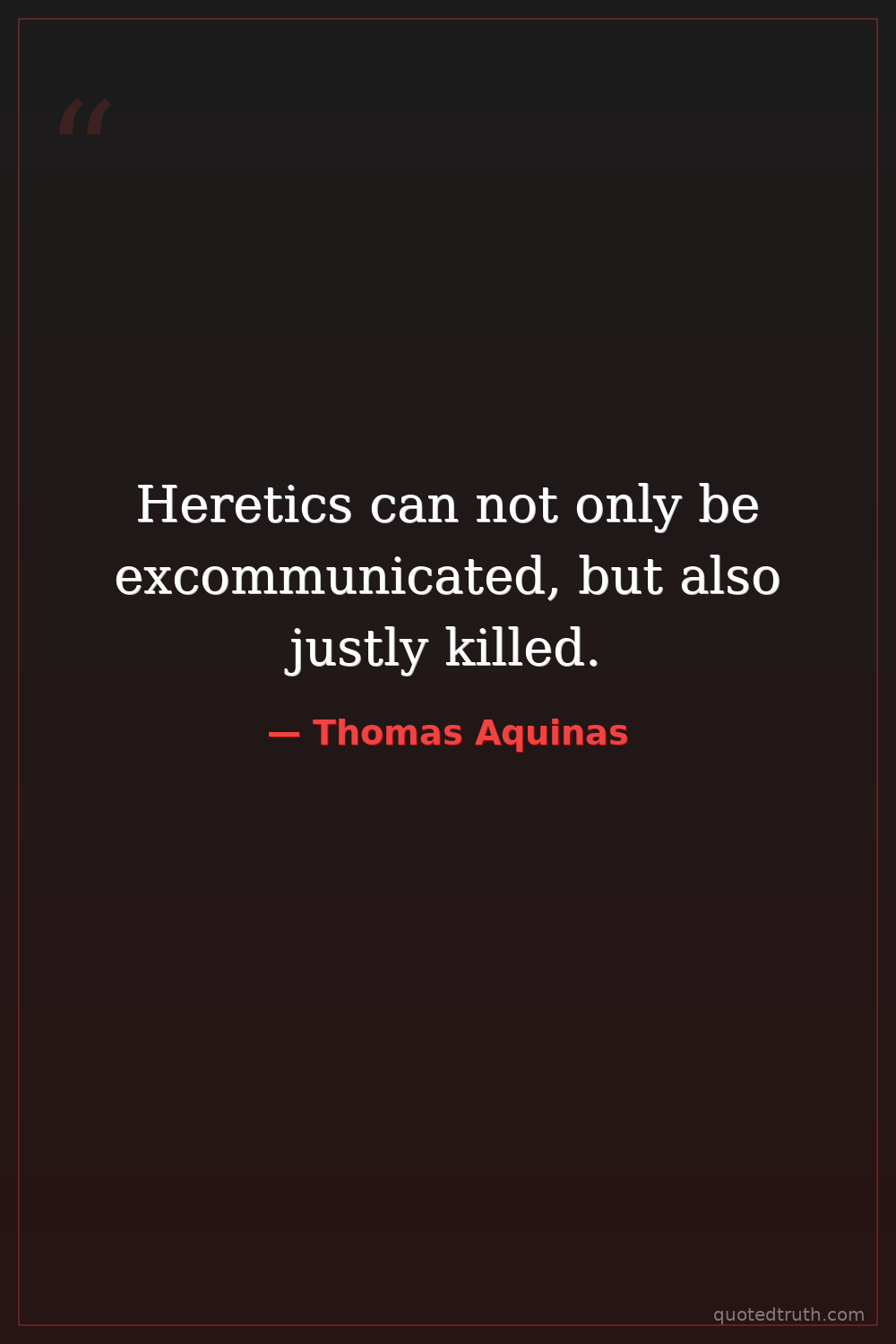
Thomas Aquinas — "Heretics can not only be excommunicated, but also justly killed."
Heretics can not only be excommunicated, but also justly killed.
Heretics can not only be excommunicated, but also justly killed.
Click any product to generate a realistic preview. Up to 3 at a time.
* Initial load can take up to 90 seconds — revising the preview in another color is nearly instant.
"It is impossible for any created intellect to comprehend God."
"It is lawful to kill a thief who is resisting arrest."
"The end of man is happiness."
"It is lawful to kill an enemy in a just war."
"It is a greater sin to steal from a rich man than from a poor man."
Found in 1 providers: grok
1 source checked
The quote asserts that people who deviate from Catholic doctrine deserve not just removal from the Church community but execution. Aquinas reasoned that heresy—corrupting spiritual truth—was a graver offense than counterfeiting currency, which society already punished by death. Since eternal souls were at stake, he argued the state was justified in killing unrepentant heretics to protect the faithful from spiritual contamination and preserve doctrinal unity.
Aquinas wrote this in his Summa Theologica (II-II, Q.11), his life's masterwork synthesizing Christian faith with Aristotelian logic. A Dominican friar who sacrificed family expectations to enter a mendicant order, his identity was inseparable from orthodoxy. He believed protecting revealed truth was a supreme moral obligation. This view was not a fringe position for him—it followed logically from his framework that eternal souls outweigh earthly life in every moral calculation.
In 13th-century Europe, heresy was simultaneously a theological crime and a civil threat to social order. The Albigensian Crusade (1209–1229) had just crushed the Cathar movement by military force. Pope Gregory IX formally established the Inquisition in 1231, institutionalizing heresy prosecution. Church and state were deeply intertwined—secular rulers enforced Church decrees under threat of their own excommunication. Aquinas wrote in a world where doctrinal uniformity was considered foundational to civilization itself.
AI-generated insights based on extensive research and information for context. Factual errors? Email [email protected].
Your cart is empty