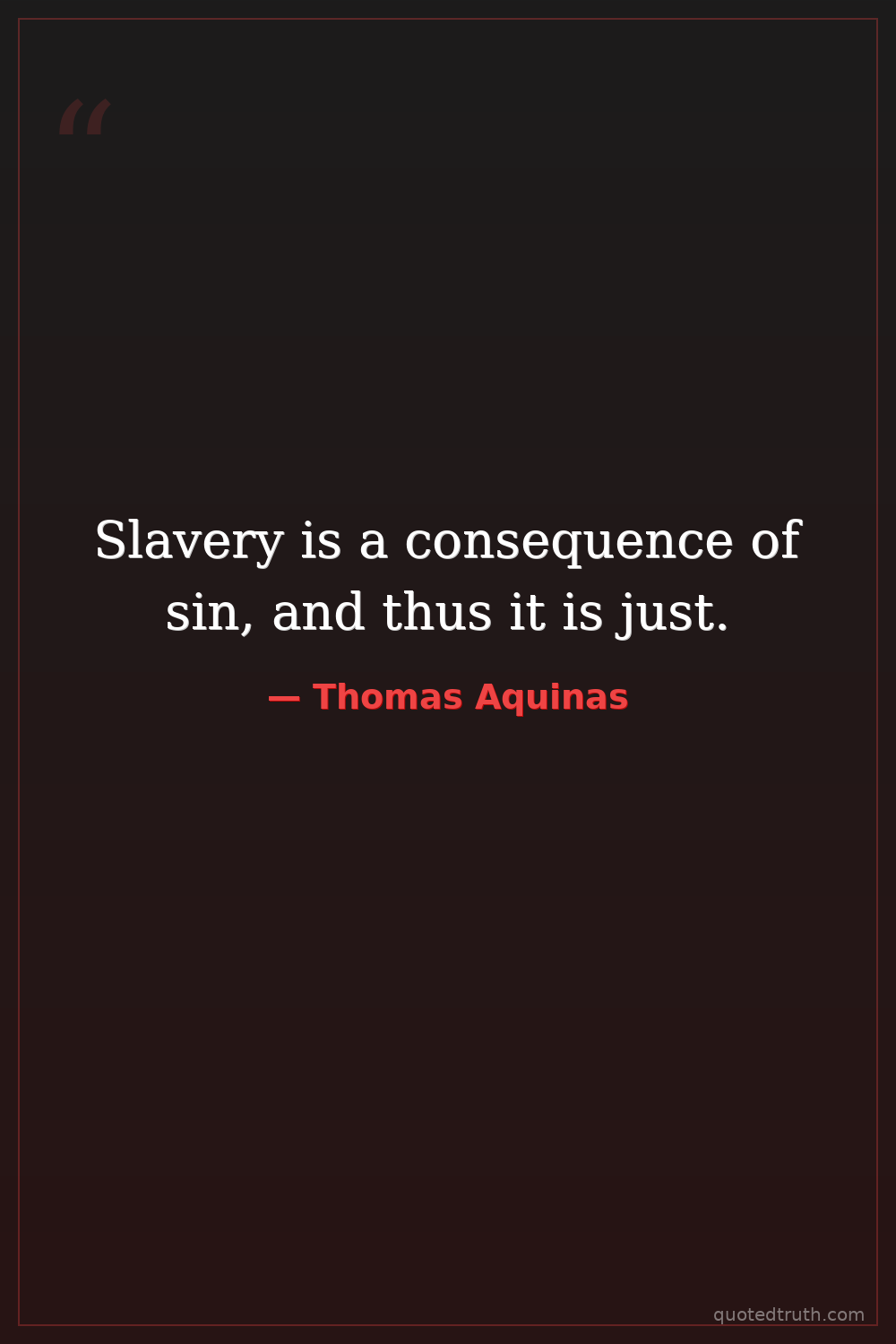
Thomas Aquinas — "Slavery is a consequence of sin, and thus it is just."
Slavery is a consequence of sin, and thus it is just.
Slavery is a consequence of sin, and thus it is just.
Click any product to generate a realistic preview. Up to 3 at a time.
* Initial load can take up to 90 seconds — revising the preview in another color is nearly instant.
"The proper object of the will is the good."
"Strictly speaking, woman is a monster of nature."
"The proper good of a thing is its perfection."
"For a woman is an imperfect man."
"The form of the human body is the soul."
Summa Theologica, Part II-II, Q. 57, Art. 3, Reply Obj. 2
Date: c. 1265-1274
Social & RacialFound in 1 providers: grok
1 source checked
Perfect natural order, Aquinas argued, contained no slavery — all humans were equal before the Fall. When sin corrupted human nature, hierarchy and coercive governance became necessary. Within the post-Fall world, slavery became permissible under the law of nations as consequence or punishment for wrongdoing. 'Just' here doesn't mean morally ideal but legally and theologically permissible within a fallen world's framework — an accommodation to corrupted human nature, not the original divine design.
Aquinas synthesized Aristotelian philosophy with Augustinian theology throughout his Summa Theologica. Augustine had argued servitude was divine punishment for sin; Aristotle defended natural hierarchy among humans. As a Dominican friar systematizing Catholic doctrine, Aquinas distinguished primary natural law (pre-Fall equality) from secondary natural law (post-Fall accommodations including property and governance). This quote reflects his method: justifying existing social institutions through theological reasoning rather than questioning their existence outright.
Thirteenth-century Europe practiced widespread serfdom and enslaved war captives from the Crusades and Reconquista. Aristotle's Politics, recently translated into Latin, had argued for natural slavery among those fit only to be ruled. The Church permitted enslaving non-Christians while condemning Christian-on-Christian enslavement. Aquinas's theological framework provided intellectual scaffolding for feudal hierarchy at a time when challenging social order was tantamount to challenging divine Providence.
AI-generated insights based on extensive research and information for context. Factual errors? Email [email protected].
Your cart is empty