Pope Urban II — "We, by the authority of Almighty God and of the blessed apostles Peter and Paul,…"
We, by the authority of Almighty God and of the blessed apostles Peter and Paul, grant to all who undertake this expedition remission of sins.
We, by the authority of Almighty God and of the blessed apostles Peter and Paul, grant to all who undertake this expedition remission of sins.
Click any product to generate a realistic preview. Up to 3 at a time.
* Initial load can take up to 90 seconds — revising the preview in another color is nearly instant.
"Let those who have formerly contended against their brothers and relatives now fight as they ought against the barbarians."
"The time has now come when you should show your zeal for Christ."
"Let those who have been accustomed to make private war against the faithful carry on an approved war against the infidels."
"It is Christ who commands it."
"Let your arms be stained with the blood of the infidels."
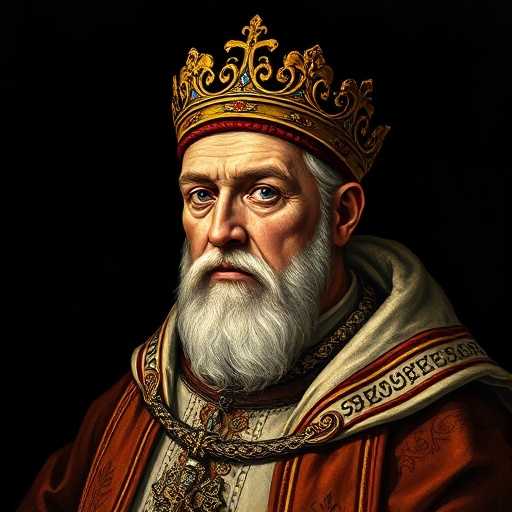
Pope (1088-1099) whose Council of Clermont speech (November 1095) launched the First Crusade — the founding event of nine centuries of Christian-Muslim military conflict. Closely associated with Pope Gregory VII (his predecessor on papal-imperial reform). For an intellectual contrast, see Saladin, Kurdish-Muslim Sultan of Egypt and Syria (1138-1193) — Saladin recaptured Jerusalem in 1187, undoing the First Crusade Urban II launched 92 years earlier. Saladin's chivalrous treatment of Christian prisoners became the canonical Muslim counter-image to Crusader brutality. The cleanest before/after pairing of the Crusades' moral arc.
Found in 1 providers: grok
1 source checked
This proclamation offers complete forgiveness of sins to anyone who joins the armed expedition to recapture Jerusalem. In plain terms: fight in this holy war and your spiritual debt to God is cancelled. The pope acts as divine intermediary, converting military service into spiritual currency. For medieval Christians terrified of divine judgment and purgatorial suffering, this was an irresistible offer — eternal salvation exchanged for earthly sacrifice on the battlefield.
Urban II, a Cluniac monk turned pope, built his career on church reform and papal supremacy. His invocation of Peter and Paul directly channels apostolic succession doctrine — popes as God's earthly representatives. He saw the Crusade as solving two problems: redirecting Europe's violent feudal knights toward a holy purpose, and reasserting Rome's authority over Christendom after decades of power struggles with secular rulers and the destabilizing 1054 Great Schism with Eastern Christianity.
At the 1095 Council of Clermont, Seljuk Turks controlled Jerusalem and blocked Christian pilgrimages. Byzantine Emperor Alexios I had pleaded for Western military aid against them. Europe's feudal knights waged constant internecine warfare with no sanctioned outlet. The Church, fresh from Gregorian Reform asserting clerical independence from kings, needed a unifying cause. Urban's indulgence weaponized medieval theology — the Church's monopoly on sin forgiveness — into a recruitment tool that mobilized tens of thousands within months.
AI-generated insights based on extensive research and information for context. Factual errors? Email [email protected].
Your cart is empty