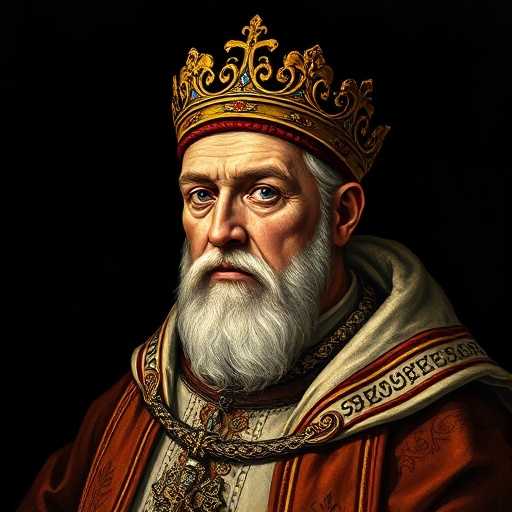
Pope Urban II — "Let those who have formerly contended against their brothers and relatives now f…"
Let those who have formerly contended against their brothers and relatives now fight as they ought against the barbarians.
Let those who have formerly contended against their brothers and relatives now fight as they ought against the barbarians.
Click any product to generate a realistic preview. Up to 3 at a time.
* Initial load can take up to 90 seconds — revising the preview in another color is nearly instant.
"Let those who have been accustomed to fight for a little gain against Christians, now fight for an eternal reward against the infidels."
"The Lord Himself will lead you."
"The land flowing with milk and honey will be yours."
"It is Jesus Christ Himself who leaves His Sepulcher and presents to you His Cross. It will be the sign that will unite the dispersed children of Israel. Raise it to your shoulders and place it on your…"
"Let those who go not put off the journey, but rent their lands and collect money for their expenses."
Pope (1088-1099) whose Council of Clermont speech (November 1095) launched the First Crusade — the founding event of nine centuries of Christian-Muslim military conflict. Closely associated with Pope Gregory VII (his predecessor on papal-imperial reform). For an intellectual contrast, see Saladin, Kurdish-Muslim Sultan of Egypt and Syria (1138-1193) — Saladin recaptured Jerusalem in 1187, undoing the First Crusade Urban II launched 92 years earlier. Saladin's chivalrous treatment of Christian prisoners became the canonical Muslim counter-image to Crusader brutality. The cleanest before/after pairing of the Crusades' moral arc.
Another exhortation to redirect internal European violence outwards against the 'barbarians' (Muslims). (Fulcher of Chartres' account)
Date: 1095
GeneralFound in 1 providers: gemini
1 source checked
Stop fighting each other and redirect your aggression toward a common enemy. People who have been locked in petty personal conflicts, feuds, and civil wars should unite their fighting energy against an outside threat instead. Turn internal division into external solidarity — the same violent impulse that tears communities apart can be channeled toward a shared cause that transcends family rivalries and local disputes.
Urban II spoke these words at the Council of Clermont in 1095, personally launching the First Crusade. As pope, his central challenge was ending the constant warfare among Christian nobles that destabilized Europe. He believed redirecting knightly violence toward Jerusalem would simultaneously liberate the Holy Land, aid Byzantine Christians, and pacify a fractious, war-torn Western Christendom — solving a domestic political crisis through foreign holy war.
Medieval Europe was plagued by endemic feudal warfare — lords, knights, and nobles in perpetual armed conflict over land, honor, and inheritance. The Peace of God and Truce of God movements had already tried curbing this violence. Simultaneously, Seljuk Turks had seized Jerusalem and threatened Byzantium. Urban's genius was fusing these crises: the Church would sanctify violence, granting crusaders spiritual merit for redirecting their swords outward rather than against fellow Christians.
AI-generated insights based on extensive research and information for context. Factual errors? Email [email protected].
Your cart is empty