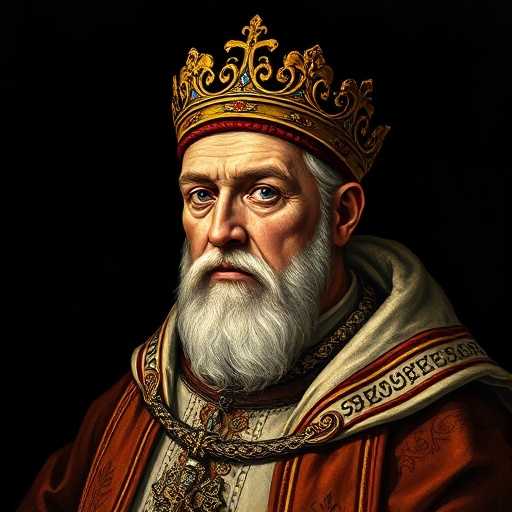
Pope Urban II — "They have destroyed the churches of God or have converted them to the rites of t…"
They have destroyed the churches of God or have converted them to the rites of their own religion.
They have destroyed the churches of God or have converted them to the rites of their own religion.
Click any product to generate a realistic preview. Up to 3 at a time.
* Initial load can take up to 90 seconds — revising the preview in another color is nearly instant.
"Fight for the Holy Sepulchre, and you will be absolved from all your sins."
"We command all of you to prepare yourselves for the journey."
"Let the aged and the infirm remain at home, but let the young and strong go forth."
"A people, a truly alien people, utterly estranged from God, has invaded the lands of the Christians and has depopulated them by sword, plunder, and fire."
"It is Jesus Christ Himself who leaves His Sepulcher and presents to you His Cross. It will be the sign that will unite the dispersed children of Israel. Raise it to your shoulders and place it on your…"
Pope (1088-1099) whose Council of Clermont speech (November 1095) launched the First Crusade — the founding event of nine centuries of Christian-Muslim military conflict. Closely associated with Pope Gregory VII (his predecessor on papal-imperial reform). For an intellectual contrast, see Saladin, Kurdish-Muslim Sultan of Egypt and Syria (1138-1193) — Saladin recaptured Jerusalem in 1187, undoing the First Crusade Urban II launched 92 years earlier. Saladin's chivalrous treatment of Christian prisoners became the canonical Muslim counter-image to Crusader brutality. The cleanest before/after pairing of the Crusades' moral arc.
Found in 1 providers: grok
1 source checked
This expresses outrage that Christian sacred places have been physically demolished or repurposed for non-Christian worship. It frames the loss not merely as territorial but as a spiritual catastrophe — God's own houses profaned. By emphasizing destruction and conversion of churches, it justifies extreme response, presenting military action as defense of the divine rather than aggression, and casting the offenders as enemies of God himself.
Pope Urban II, born Odo of Châtillon, was a Cluniac monk before becoming pope — his monastic formation made reverence for sacred physical spaces central to his identity. As head of Christendom, he bore responsibility for protecting God's universal church. This quote directly reflects his Council of Clermont speech in 1095, where desecration of holy sites was his primary moral argument for calling knights to armed pilgrimage to reclaim Jerusalem.
By 1095, Seljuk Turks controlled Jerusalem and much of Anatolia after defeating Byzantium at Manzikert in 1071. Christian pilgrims reported restricted access and abuse at holy sites. Emperor Alexios I appealed to Rome for military aid. Western Europe was experiencing intense piety, the Cluniac reform movement, and a warrior culture seeking spiritual purpose. The claim that God's houses were being violated by infidels was a powerful rallying cry in this feudal, deeply devotional society.
AI-generated insights based on extensive research and information for context. Factual errors? Email [email protected].
Your cart is empty