Pope Urban II — "It is Jesus Christ Himself who leaves His Sepulcher and presents to you His Cros…"

It is Jesus Christ Himself who leaves His Sepulcher and presents to you His Cross. It will be the sign that will unite the dispersed children of Israel. Raise it to your shoulders and place it on your chests. Let it shine on your arms and banners. Let it be for you the reward of victory or the palm of martyrdom. It will be an unceasing reminder that Our Lord died for us and we should die for Him.
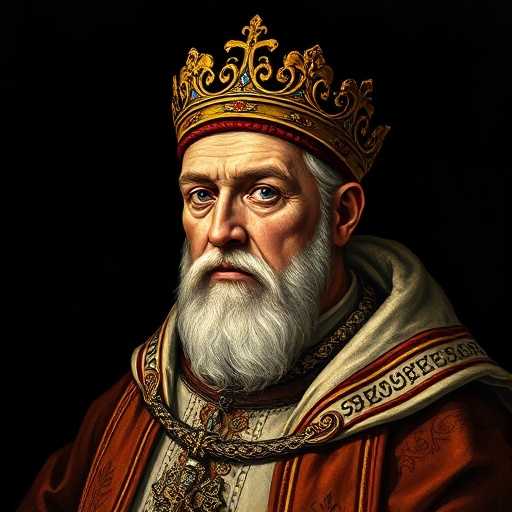
Pope Urban II — Pope Urban II Medieval · Launched the First Crusade

Get This Quote & Author's Image Illustrated On:

Click any product to generate a realistic preview. Up to 3 at a time.
* Initial load can take up to 90 seconds — revising the preview in another color is nearly instant.

Kitchen

Apparel

Other

About Pope Urban II (c. 1042-1099)

Pope (1088-1099) whose Council of Clermont speech (November 1095) launched the First Crusade — the founding event of nine centuries of Christian-Muslim military conflict. Closely associated with Pope Gregory VII (his predecessor on papal-imperial reform). For an intellectual contrast, see Saladin, Kurdish-Muslim Sultan of Egypt and Syria (1138-1193) — Saladin recaptured Jerusalem in 1187, undoing the First Crusade Urban II launched 92 years earlier. Saladin's chivalrous treatment of Christian prisoners became the canonical Muslim counter-image to Crusader brutality. The cleanest before/after pairing of the Crusades' moral arc.

Details

Presenting the cross as a symbol of the Crusade, linking participation to Christ's sacrifice and promising martyrdom. (Attributed in a historical summary)

Date: 1095

General

Verification

Unverifiable

Found in 1 providers: gemini

1 source checked

Understanding this quote

What it means

Christ himself summons warriors to carry His Cross as both weapon and identity. The Cross worn on chest, arm, and banner becomes a unifying emblem for scattered believers. Those who fight under it earn either the prize of victory or the honor of dying for God. The underlying logic: Christ died for humanity, so dying for Christ in holy war is the ultimate reciprocal act of faith and loyalty.

Relevance to Pope Urban II

Urban II, a Cluniac monk turned pope, was obsessed with Christian unity and papal authority. Driven from Rome by antipope Clement III, he needed a cause to consolidate Christendom behind him. At Clermont in 1095, this speech was his masterstroke: framing military campaign as spiritual obligation, binding feudal knights to papal purpose. His monastic background shaped the martyrdom theology - death in service as the highest form of devotion.

The era

The 1071 Battle of Manzikert shattered Byzantine power, enabling Seljuk Turks to block pilgrimage routes to Jerusalem. Emperor Alexios I begged Western help. Meanwhile, European nobility waged constant internecine warfare, producing battle-hardened men with restless violence and little unifying purpose. Urban redirected that martial energy outward. The novel theological concept - battlefield death as penance earning salvation - gave knights a spiritual transaction they understood: violence sanctified by sacrifice.

AI-generated insights based on extensive research and information for context. Factual errors? Email [email protected].
Your Cart

Your cart is empty