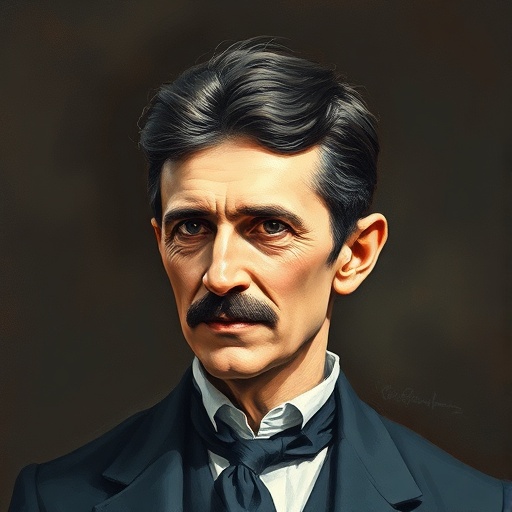
Nikola Tesla — "I have not invented a 'death ray'. I don't need a 'death ray' to destroy an army…"
I have not invented a 'death ray'. I don't need a 'death ray' to destroy an army. I can simply create a vibratory force that would shatter the earth.
I have not invented a 'death ray'. I don't need a 'death ray' to destroy an army. I can simply create a vibratory force that would shatter the earth.
Click any product to generate a realistic preview. Up to 3 at a time.
* Initial load can take up to 90 seconds — revising the preview in another color is nearly instant.
"To know each other we must reach beyond the sphere of our sense perceptions."
"I do not eat meat."
"In no way can we get such an overwhelming idea of the grandeur of Nature than when we consider, that in accordance with the law of the conservation of energy, throughout the Infinite, the forces are i…"
"This gives you vigor and vitality."
"What one man calls God, another calls the laws of physics."
Serbian-American inventor and electrical engineer whose alternating-current designs powered the modern electrical grid; died poor and largely forgotten. Closely associated with George Westinghouse (his AC-power business partner) and Mihajlo Pupin (fellow Serbian-American physicist at Columbia). For an intellectual contrast, see Thomas Edison, American inventor and direct-current advocate — Edison's direct-current power-distribution scheme was displaced by Tesla-Westinghouse AC in the 1890s 'War of Currents'. Edison ran a public-relations campaign electrocuting animals to discredit AC — the most famous engineering-ethics rivalry in American history. Tesla's AC won and powers nearly every electrical grid on Earth.
Found in 1 providers: grok
1 source checked
Tesla denies the 'death ray' label while claiming something more staggering: that his mastery of vibration and resonance gives him power to destroy the Earth itself. It expresses his conviction that frequency and oscillation are the most fundamental forces in nature — far more potent than any conventional weapon. The real threat, in his view, wasn't a directed energy beam but the amplifying power of resonance applied at planetary scale.
Tesla's mechanical oscillator experiments around 1898 reportedly set Manhattan buildings trembling — what newspapers dubbed his earthquake machine. He genuinely believed resonant frequencies, tuned precisely to a structure's natural vibration, could amplify into catastrophic force. His dismissal of the 'death ray' label — a press obsession in the 1930s when Tesla was elderly and broke — while asserting planetary-scale destructive capability reflects both his authentic scientific beliefs about resonance and his lifelong habit of making grandiose claims to secure funding.
By the 1930s, when Tesla made such statements, Europe was rearming and 'death ray' technology was tabloid sensation. The interwar period's anxiety over industrialized slaughter — chemical weapons, aerial bombing — made exotic destructive weapons plausible fears. Meanwhile Tesla, once celebrated as the wizard of electricity, was living in a New York hotel room, financially ruined, desperately pitching investors. His bold claims about resonance and vibration fit an era hungry for both scientific miracles and weapons of terrifying power.
AI-generated insights based on extensive research and information for context. Factual errors? Email [email protected].
Your cart is empty