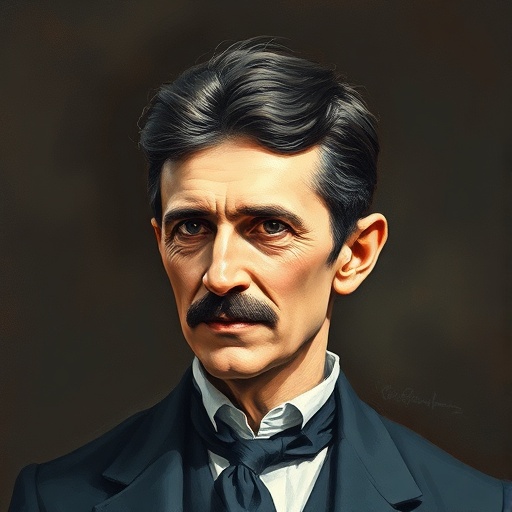
Nikola Tesla — "What one man calls God, another calls the laws of physics."
What one man calls God, another calls the laws of physics.
What one man calls God, another calls the laws of physics.
Click any product to generate a realistic preview. Up to 3 at a time.
* Initial load can take up to 90 seconds — revising the preview in another color is nearly instant.
"We crave for new sensations but soon become indifferent to them. The wonders of yesterday are today common occurrences."
"The greatest discovery of all time will be the discovery of a new source of energy."
"The greatest discoveries have been made by men of science who have not been afraid to depart from the beaten path."
"The spread of civilization may be likened to a fire; first, a feeble spark, next a flickering flame, then a mighty blaze, ever increasing in speed and power."
"The present is theirs; the future, for which I have really worked, is mine."
Serbian-American inventor and electrical engineer whose alternating-current designs powered the modern electrical grid; died poor and largely forgotten. Closely associated with George Westinghouse (his AC-power business partner) and Mihajlo Pupin (fellow Serbian-American physicist at Columbia). For an intellectual contrast, see Thomas Edison, American inventor and direct-current advocate — Edison's direct-current power-distribution scheme was displaced by Tesla-Westinghouse AC in the 1890s 'War of Currents'. Edison ran a public-relations campaign electrocuting animals to discredit AC — the most famous engineering-ethics rivalry in American history. Tesla's AC won and powers nearly every electrical grid on Earth.
Reflecting on the relationship between science and spirituality.
Date: Approximate
PhilosophicalFound in 1 providers: gemini
1 source checked
The quote suggests that 'God' and 'the laws of physics' are two names for the same underlying reality — one used by the religious, one by the scientific. It is not an attack on faith but a unifying claim: the awe, order, and mystery that believers attribute to a divine creator are the very same phenomena scientists describe through mathematics and natural law. Different vocabularies, identical wonder.
Tesla spent his life decoding nature's invisible forces — electromagnetic fields, alternating current, resonance — treating each discovery as uncovering a pre-existing cosmic order. Though raised Serbian Orthodox, he drifted from organized religion while retaining deep reverence for the universe's elegant design. He described electricity as a force governing all matter. For Tesla, science was not a rejection of the sacred but its most precise expression.
Tesla's most productive decades, the 1880s–1920s, coincided with fierce conflict between scientific materialism and religious authority. Darwin's evolution theory had shaken Victorian society, and electrical science was transforming daily life in ways once attributed to miracles. Intellectuals debated whether a mechanistic universe left room for God. Tesla's framing offered a bridge — honoring both the religious impulse and empirical rigor — at a moment when many felt forced to choose between them.
AI-generated insights based on extensive research and information for context. Factual errors? Email [email protected].
Your cart is empty