What it means
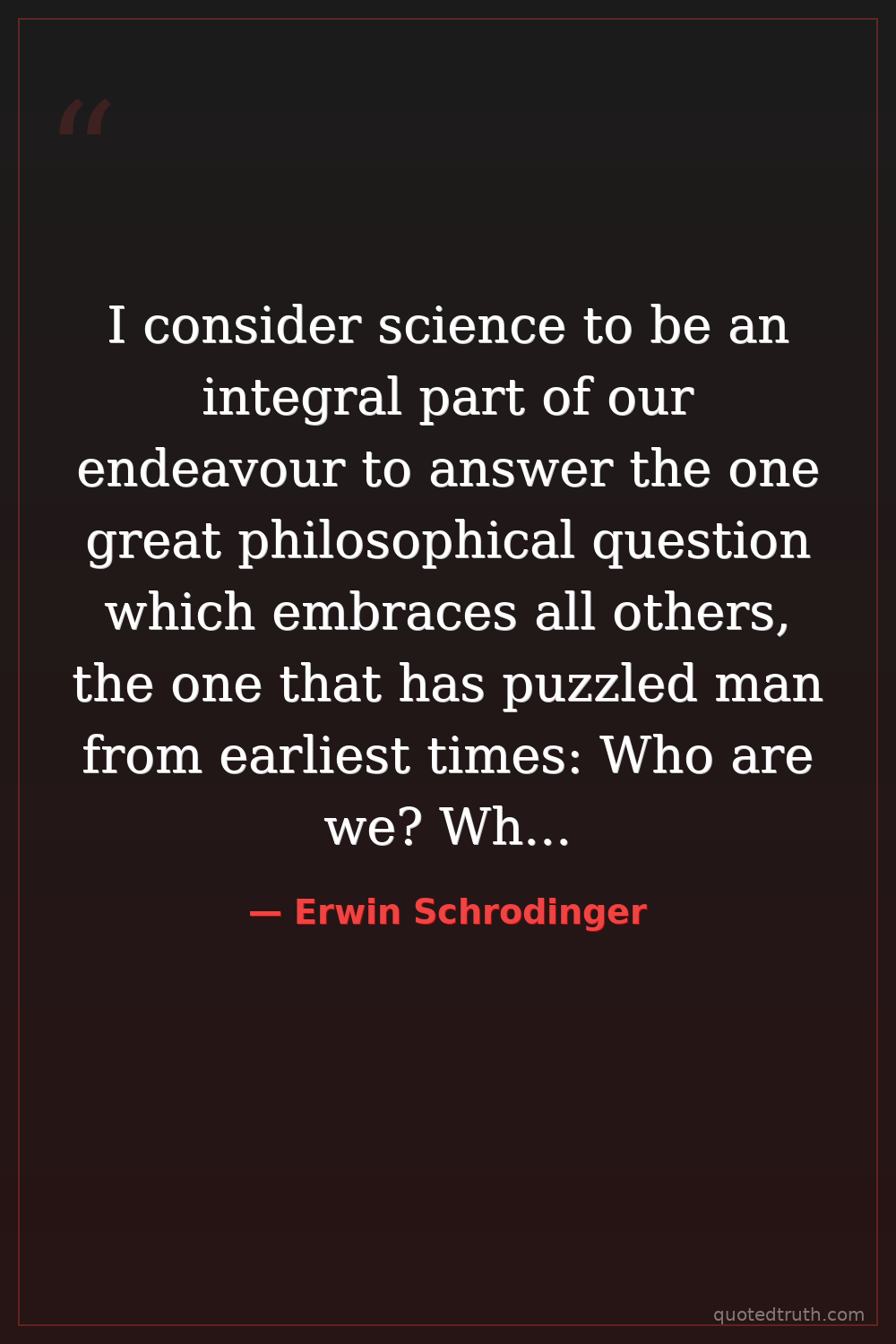
Science is not separate from philosophy but is one tool among many we use to answer the deepest human question: what is the nature of human existence and consciousness? Rather than treating science as purely technical or utilitarian, it belongs to the same ancient quest that drives religion, philosophy, and art — understanding who and what we fundamentally are.
Relevance to Erwin Schrodinger
Schrödinger, who formulated wave mechanics and the quantum wave equation, was unusual among physicists for his deep philosophical interests. He wrote 'What Is Life?' bridging physics and biology, and studied Vedantic philosophy seriously. He saw his quantum work not as mere calculation but as part of understanding the nature of reality and consciousness — making this quote autobiographical.
The era
Schrödinger lived through quantum mechanics' birth in the 1920s-30s, a period that shattered classical determinism and forced physicists to confront fundamental questions about observation, reality, and the role of the observer. Simultaneously, two World Wars shook confidence in pure rationalism. Scientists increasingly felt compelled to address deeper human questions science had seemingly displaced but never actually answered.
AI-generated insights based on extensive research and information for context. Factual errors? Email [email protected].