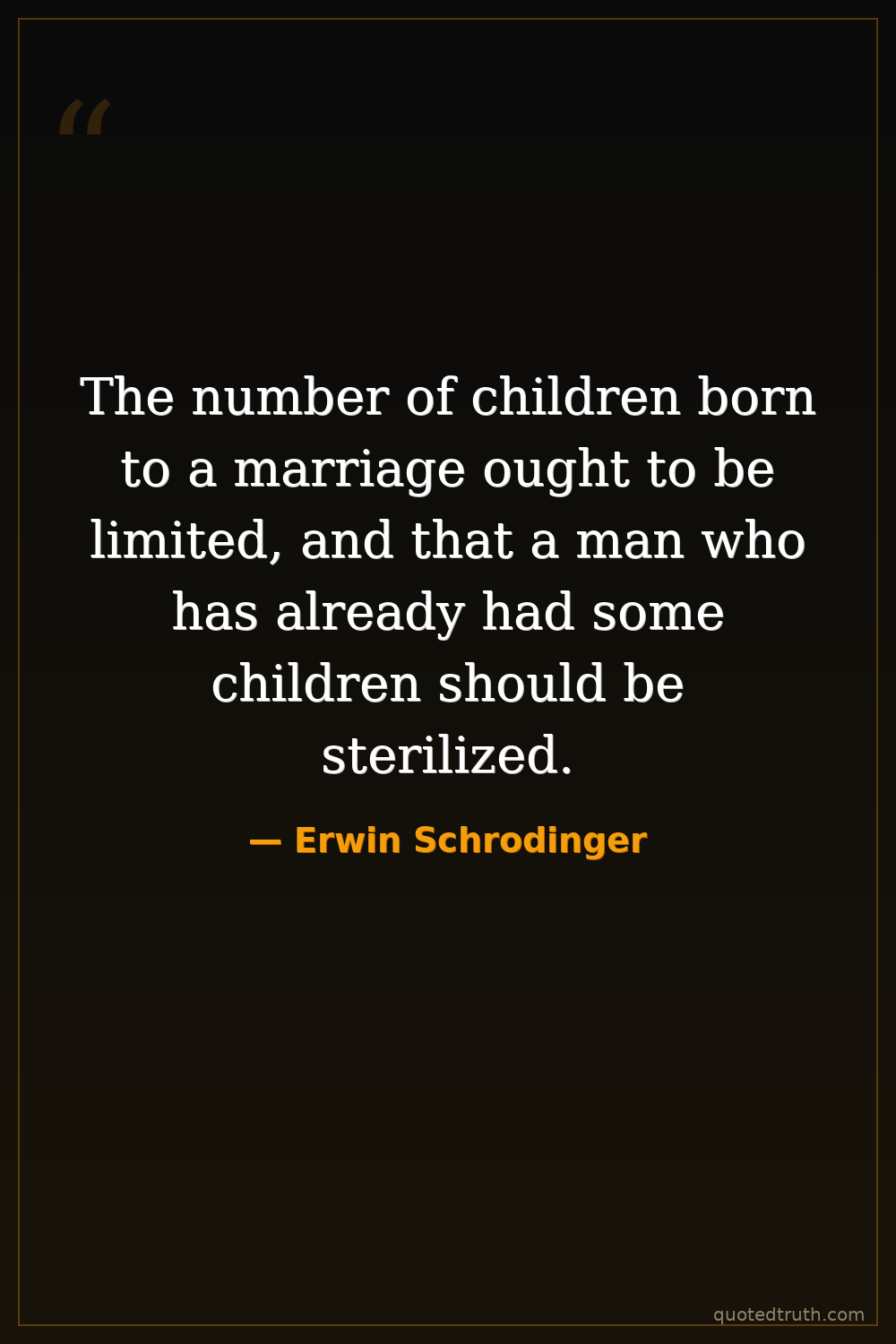
Erwin Schrodinger — "The number of children born to a marriage ought to be limited, and that a man wh…"
The number of children born to a marriage ought to be limited, and that a man who has already had some children should be sterilized.
The number of children born to a marriage ought to be limited, and that a man who has already had some children should be sterilized.
Click any product to generate a realistic preview. Up to 3 at a time.
* Initial load can take up to 90 seconds — revising the preview in another color is nearly instant.
"The human mind is a universe in itself."
"The fundamental laws of physics are statistical. They do not determine precisely what will happen, but only the probability of what will happen."
"The only constant in life is change."
"The scientific picture of the world is a simplification, an abstraction, and it is not the whole truth."
"I am enough of an artist to draw freely upon my imagination."
Austrian physicist who shared the 1933 Nobel for the wave equation that bears his name and the famous cat thought-experiment. Closely associated with Werner Heisenberg (matrix-mechanics rival who reached the same physics by different math) and Albert Einstein (his pen-pal on quantum interpretation). For an intellectual contrast, see Niels Bohr, Danish physicist and architect of the Copenhagen interpretation — Schrödinger's cat thought-experiment was specifically designed to ridicule Bohr's 'observer-dependent reality' reading of quantum mechanics — Schrödinger thought the Copenhagen interpretation was absurd; the cat was meant as reductio ad absurdum.
From a letter to Arnold Sommerfeld, expressing controversial eugenicist views.
Date: 1927
ShockingFound in 1 providers: grok
1 source checked
This quote advocates limiting births per marriage and sterilizing men who have already fathered children. It reflects eugenicist ideology — the belief that human reproduction should be scientifically controlled for societal benefit. Today this is recognized as a profound violation of bodily autonomy and human rights, associated with coercive population management programs that caused immense harm and have been thoroughly discredited by history and modern ethics.
Schrödinger's intellectual curiosity extended far beyond wave mechanics — his book 'What Is Life?' bridged physics and biology, reflecting his drive to unify knowledge about living systems. Like many European academics of his Vienna-educated generation, he absorbed eugenics as legitimate science. This quote reveals how even a Nobel Prize-winning mind could internalize the dangerous ideological assumptions dominant in early 20th-century scientific and intellectual circles.
During Schrödinger's active years, eugenics was mainstream academic science, founded by Francis Galton and embraced widely by the 1920s–30s. Over 30 U.S. states enacted forced sterilization laws; Sweden, Britain, and Germany followed. The Nazi regime's systematic murder of those deemed 'unfit' exposed eugenics as catastrophically immoral. By mid-century it was broadly discredited, but not before hundreds of thousands were forcibly sterilized or killed under its justifications.
AI-generated insights based on extensive research and information for context. Factual errors? Email [email protected].
Your cart is empty