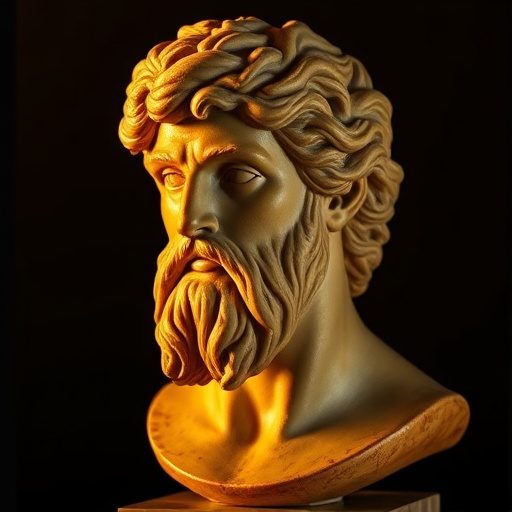
Pythagoras — "Don't mix a fire with a knife."
Don't mix a fire with a knife.
Don't mix a fire with a knife.
Click any product to generate a realistic preview. Up to 3 at a time.
* Initial load can take up to 90 seconds — revising the preview in another color is nearly instant.
"Time is the soul of this world."
"Numbers rule the universe."
"As long as Man continues to be the ruthless destroyer of lower living beings, he will never know health or peace. For as long as men massacre animals, they will kill each other. Indeed, he who sows th…"
"Turn sharp blades away from you."
"Do not look in a mirror by lamplight."
Greek philosopher and mathematician whose school in Croton combined geometry (the Pythagorean theorem), number-mysticism, and a religious-vegetarian way of life. Closely associated with Thales of Miletus (earlier pre-Socratic and the first philosopher). For an intellectual contrast, see Heraclitus, pre-Socratic Greek philosopher of flux — Heraclitus called Pythagoras 'the chief of swindlers' — among the founding insults of the philosophical-rivalry tradition. Their 'all is flux' vs 'all is number' poles still organize the philosophy of mathematics today (Platonist vs anti-realist).
A Pythagorean 'Symbol', interpreted by Diogenes Laertius as 'not inciting the rage or swollen anger of people in power'.
Date: c. 570-495 BCE (interpreted 3rd century CE)
WisdomFound in 1 providers: gemini
1 source checked
Warning against escalating conflict — fire represents a heated, volatile situation or an already-angry person; a knife represents sharp provocation or aggression. Adding one to the other intensifies danger. In plain terms: don't antagonize someone already enraged, and don't let a tense situation turn explosive by introducing something sharper into it. When emotions are running hot, pulling out something cutting only makes things worse.
Pythagoras ran a philosophical brotherhood in Croton, southern Italy, governed by cryptic rules called akusmata — symbolic precepts handed to initiates. As a community leader combining mathematics, ethics, and mysticism, he encoded behavioral wisdom in metaphor. His system demanded self-discipline and harmony above all. Fire-and-knife is classic Pythagorean style: a concrete image conveying a social rule. Managing volatile personalities in a tight-knit commune made conflict-restraint a practical priority, not just abstract philosophy.
In 6th-century BCE Magna Graecia — Greek colonies of southern Italy — philosophical schools were also political factions. Pythagorean brotherhoods wielded real civic power in Croton and Metapontum, making internal harmony existential. Greek city-states ran on honor culture where perceived insults triggered vendettas. Oral wisdom traditions, from Delphi's maxims to Pythagorean akusmata, were how communities encoded behavioral norms before written law dominated. Escalating conflicts could fracture alliances and invite exile or worse.
AI-generated insights based on extensive research and information for context. Factual errors? Email [email protected].
Your cart is empty