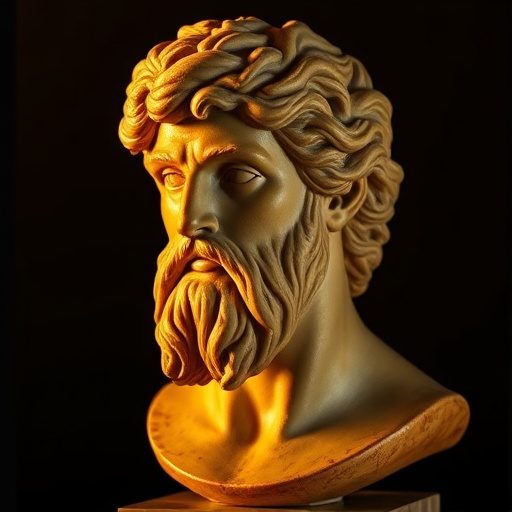
Pythagoras — "The earth is a sphere."
The earth is a sphere.
The earth is a sphere.
Click any product to generate a realistic preview. Up to 3 at a time.
* Initial load can take up to 90 seconds — revising the preview in another color is nearly instant.
"Do nothing evil, neither in the presence of others, nor privately; But above all things respect yourself."
"Friends are as companions on a journey, who ought to aid each other to persevere in the road to a happier life."
"There is nothing so easy but that it becomes difficult when you do it reluctantly."
"The wise man should be prepared for everything that does not lie within his power."
"Do not look in a mirror by lamplight."
Greek philosopher and mathematician whose school in Croton combined geometry (the Pythagorean theorem), number-mysticism, and a religious-vegetarian way of life. Closely associated with Thales of Miletus (earlier pre-Socratic and the first philosopher). For an intellectual contrast, see Heraclitus, pre-Socratic Greek philosopher of flux — Heraclitus called Pythagoras 'the chief of swindlers' — among the founding insults of the philosophical-rivalry tradition. Their 'all is flux' vs 'all is number' poles still organize the philosophy of mathematics today (Platonist vs anti-realist).
Pythagoreans were among the first to propose a spherical Earth, though not universally accepted at the time.
Date: c. 570 – c. 495 BC
ShockingFound in 1 providers: grok
1 source checked
The planet we live on is round, shaped like a ball, not flat. Despite how the ground appears level under our feet, the whole Earth curves in every direction, forming a three-dimensional globe. This simple statement asserts a physical truth about our world's geometry that contradicts everyday sensory experience, insisting instead on a deeper reality discoverable through reasoning, observation of shadows, ships disappearing over horizons, and geometric principles.
Pythagoras founded a philosophical brotherhood obsessed with numbers, geometry, and cosmic harmony. He and his followers are credited as among the first Greeks to argue Earth is spherical, likely reasoning from the sphere's mathematical perfection and symmetry. For a mind that saw numeric order behind reality and believed celestial bodies moved in harmonious ratios, a round Earth fit his conviction that the universe obeys elegant geometric laws rather than chaotic flat assumptions.
In the 6th century BCE, most Greeks and neighboring cultures imagined Earth as a flat disc floating on water or surrounded by ocean, following Homeric and Near Eastern traditions. Natural philosophy was just emerging in Ionia, with thinkers like Thales and Anaximander proposing rational explanations for nature. Pythagoras's sphere claim was radical, pre-dating Aristotle's empirical arguments by two centuries and Eratosthenes's measurement by four, marking an early triumph of abstract reasoning over appearance.
AI-generated insights based on extensive research and information for context. Factual errors? Email [email protected].
Your cart is empty