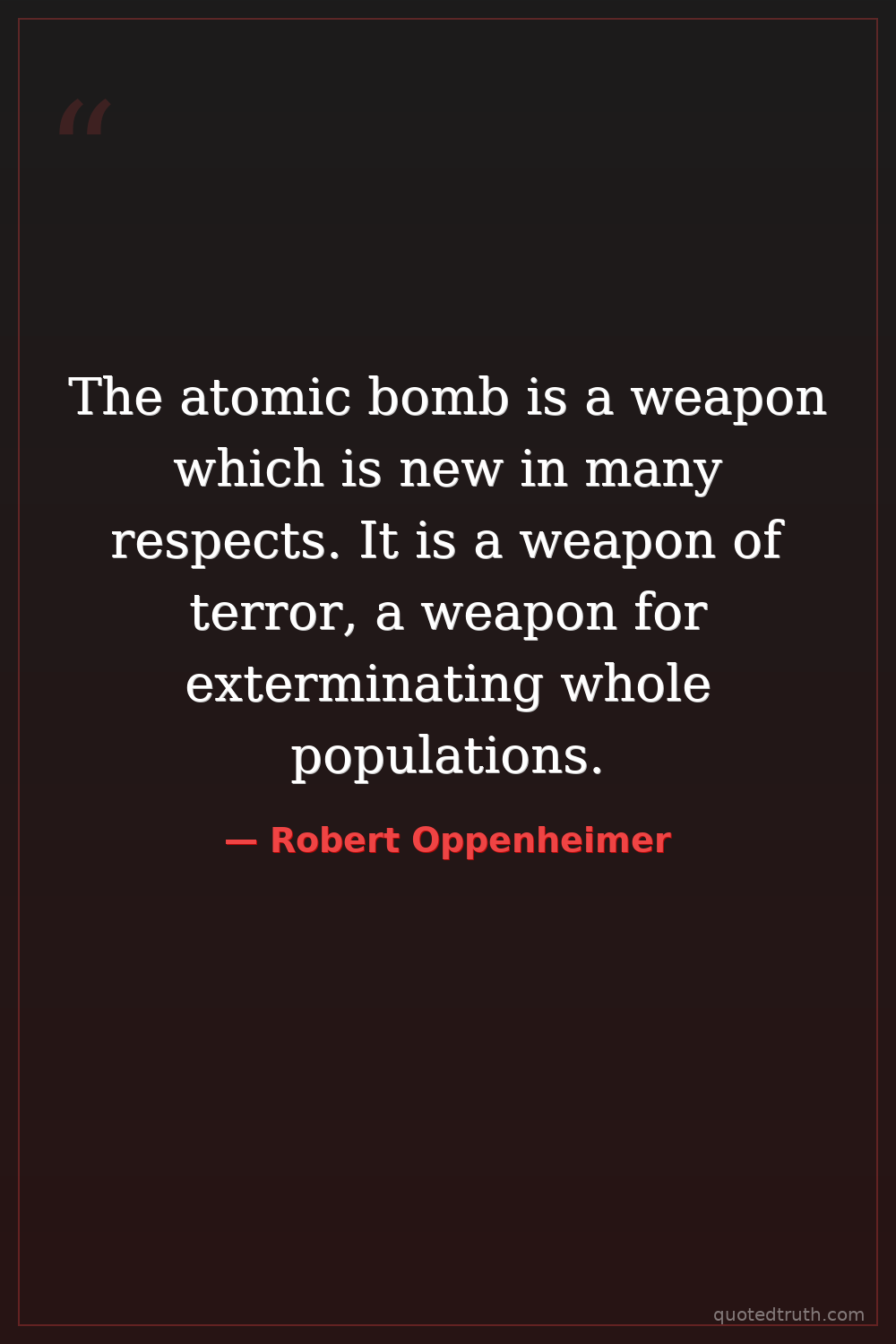
Robert Oppenheimer — "The atomic bomb is a weapon which is new in many respects. It is a weapon of ter…"
The atomic bomb is a weapon which is new in many respects. It is a weapon of terror, a weapon for exterminating whole populations.
The atomic bomb is a weapon which is new in many respects. It is a weapon of terror, a weapon for exterminating whole populations.
Click any product to generate a realistic preview. Up to 3 at a time.
* Initial load can take up to 90 seconds — revising the preview in another color is nearly instant.
"The best way to predict the future is to create it."
"We have made a thing, a most terrible weapon, that has altered the nature of the world. We have made a thing that has made it impossible for us to live without changing our whole way of life."
"My childhood did not prepare me for the fact that the world is full of cruel and bitter things."
"We have created a monster."
"We may be likened to two scorpions in a bottle, each capable of killing the other, but only at the risk of his own life."
American theoretical physicist who directed the Manhattan Project's Los Alamos Laboratory and oversaw the atomic bombs; lost his security clearance in 1954. Closely associated with Niels Bohr (Manhattan Project consultant and atomic-policy advisor) and Hans Bethe (Los Alamos theoretical-division chief). For an intellectual contrast, see Edward Teller, Hungarian-American physicist and 'father of the H-bomb' — Teller pushed the H-bomb against Oppenheimer's objections and testified against him at his 1954 security hearing — the precise moment that ended Oppenheimer's career. The canonical 'physicist-of-conscience vs physicist-of-state' pairing in nuclear-age ethics; Christopher Nolan's Oppenheimer (2023) dramatized this rivalry for a mass audience.
Found in 1 providers: grok
1 source checked
The atomic bomb is fundamentally unlike any previous weapon—it doesn't target soldiers or military infrastructure but entire cities and civilian populations. It operates through terror: the knowledge of its existence and potential use paralyzes nations. This acknowledges the bomb's qualitative leap beyond conventional warfare into a realm of mass extermination, making it a tool of civilian genocide rather than traditional combat between armed forces.
Oppenheimer personally directed the scientific team that built the first atomic bombs at Los Alamos. After Hiroshima and Nagasaki killed over 200,000 people, he was consumed by guilt, quoting the Bhagavad Gita: 'Now I am become Death.' He later lobbied against the hydrogen bomb and advocated for international nuclear controls, ultimately losing his security clearance in 1954 partly for opposing further weapons escalation.
Spoken in the immediate post-WWII period, as the United States held a temporary nuclear monopoly and the Soviet Union raced to build its own bomb. Hiroshima and Nagasaki had just demonstrated that cities could be incinerated in seconds, killing hundreds of thousands instantly. Policymakers debated whether nuclear weapons were legitimate military tools or fundamentally different instruments requiring entirely new international law and arms governance frameworks.
AI-generated insights based on extensive research and information for context. Factual errors? Email [email protected].
Your cart is empty