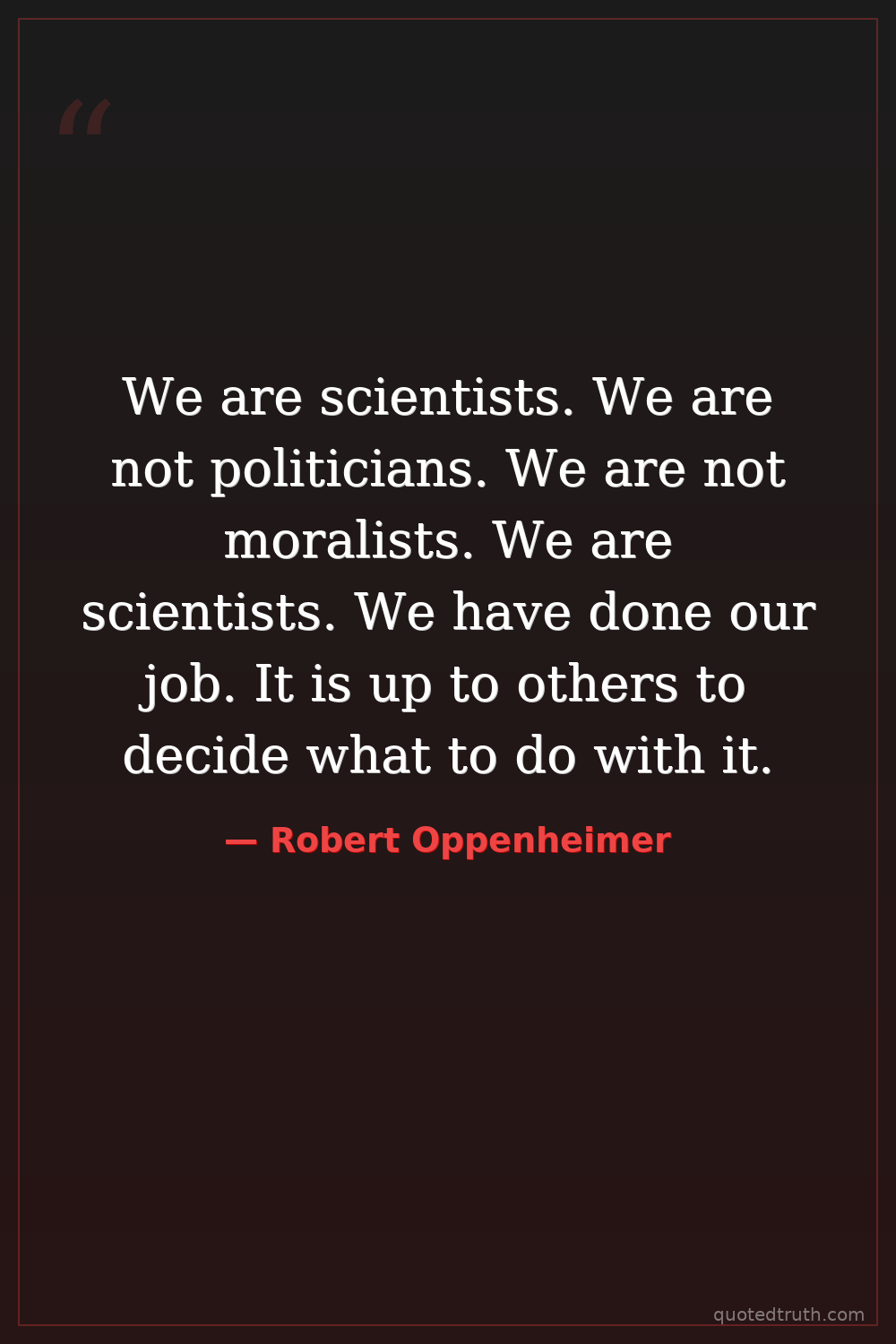
What it means
Scientists build and discover; they don't govern or judge. This quote asserts that scientific work is separable from its consequences—that the researcher's job ends at delivery, and responsibility for application belongs to policymakers and society. It captures the logic of professional compartmentalization: expertise in creation does not obligate involvement in decisions about use, placing moral weight squarely on those with political power.
Relevance to Robert Oppenheimer
Oppenheimer directed Los Alamos, the laboratory that built the first atomic bombs. After Hiroshima, he reportedly said, 'Now I am become Death, the destroyer of worlds.' Though this quote claims scientific detachment, Oppenheimer later lobbied against the hydrogen bomb and pushed for international arms control—directly contradicting its premise. His 1954 security clearance revocation, driven partly by these moral positions, shows how profoundly he rejected this stance in practice.
The era
The Manhattan Project (1942–1945) mobilized 130,000 workers and spent $2 billion to build nuclear weapons before the Soviet Union could. Scientists recruited to defeat Nazi Germany found themselves delivering bombs dropped on Japanese cities. The post-war years saw the founding of the Bulletin of the Atomic Scientists and fierce debate over whether researchers bore moral responsibility for their discoveries—a reckoning that reshaped scientific ethics permanently.
AI-generated insights based on extensive research and information for context. Factual errors? Email [email protected].