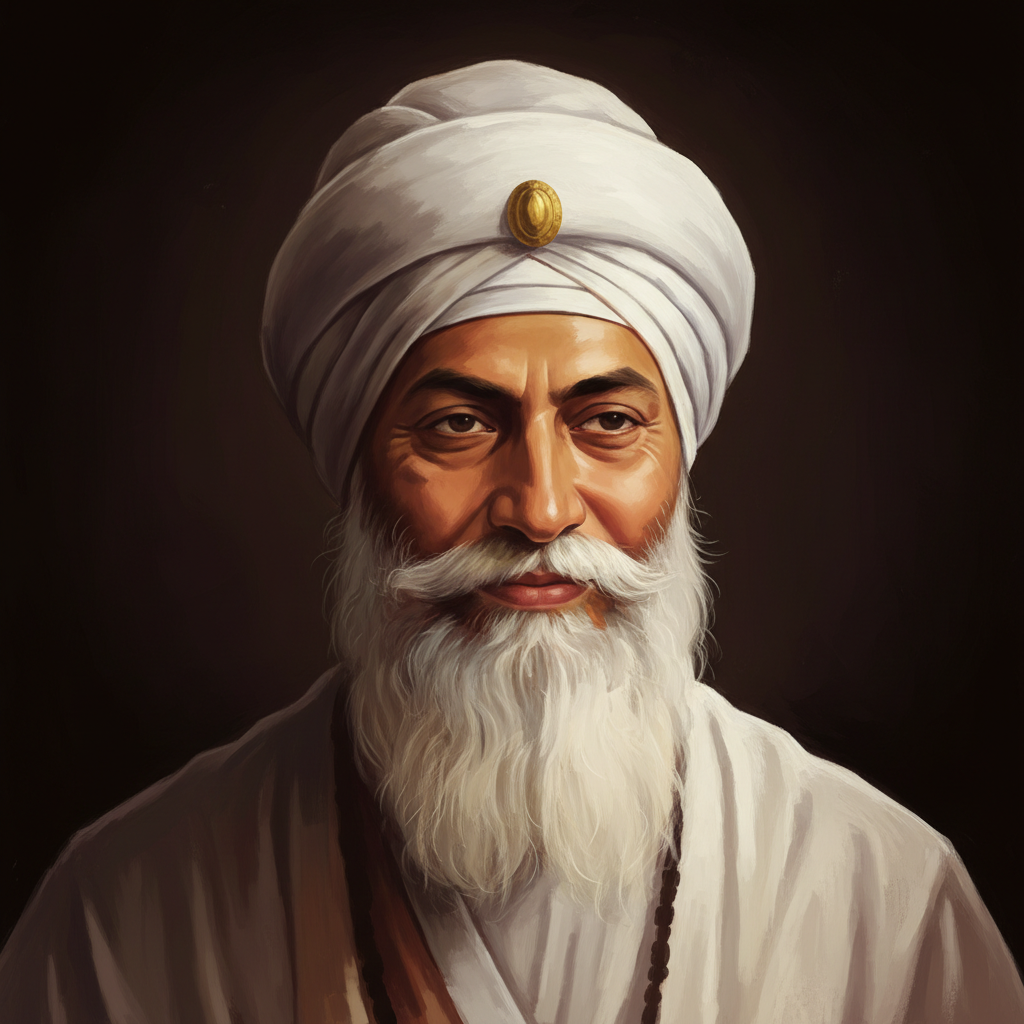
Guru Nanak — "Why do you call her inferior, when from her, kings are born?"
Why do you call her inferior, when from her, kings are born?
Why do you call her inferior, when from her, kings are born?
Click any product to generate a realistic preview. Up to 3 at a time.
* Initial load can take up to 90 seconds — revising the preview in another color is nearly instant.
"God is one, but he has innumerable forms. He is the creator of all and He himself takes the human form."
"Realization of Truth is higher than all else. Higher still is truthful living."
"The whole creation is His temple."
"Like the juggler, deceiving by his tricks, one is deluded by egotism, falsehood and illusion."
"Material wealth is temporary, while love and spiritual devotion are eternal."
Founder of Sikhism and the first of the Ten Sikh Gurus, whose teachings of one universal God and rejection of caste shaped Punjab. Closely associated with Kabir (mystical poet whose verses appear in the Sikh Guru Granth Sahib). For an intellectual contrast, see Brahmanical orthodoxy, the Hindu caste-and-ritual establishment of his era — Sikhism was founded as a deliberate alternative to both Hindu ritual hierarchy and Islamic exclusivism — Nanak's universalism was a structural rejection of caste and priestly mediation.
From the Guru Granth Sahib, challenging gender inequality.
Date: c. 15th-16th century
GeneralFound in 1 providers: gemini
1 source checked
Dismissing women as lesser beings is logically incoherent — the very rulers and great men societies exalt were carried, birthed, and raised by women. If women were truly inferior, how could they produce those deemed superior? This challenges the circular reasoning behind patriarchal hierarchies, demanding respect for women on the basis of their fundamental role in human dignity and continuity.
Guru Nanak openly challenged caste discrimination, religious hypocrisy, and gender inequality — radical positions for a 15th-century Punjab holy man. He included women in congregational worship, composed hymns honoring them, and rejected the orthodox Hindu practice of excluding women from spiritual life. This quote directly reflects his lived advocacy for women's equal spiritual standing within the nascent Sikh community he founded.
In 15th-16th century Punjab, women faced severe restrictions under both Hindu caste conventions and patriarchal tribal customs reinforced by Mughal-era social norms. Female infanticide, purdah, and exclusion from religious ceremonies were widespread. Guru Nanak's challenge was politically and spiritually subversive — publicly questioning the male-dominated structures of both Hindu and Islamic societies simultaneously, making this declaration genuinely dangerous and revolutionary.
AI-generated insights based on extensive research and information for context. Factual errors? Email [email protected].
Your cart is empty