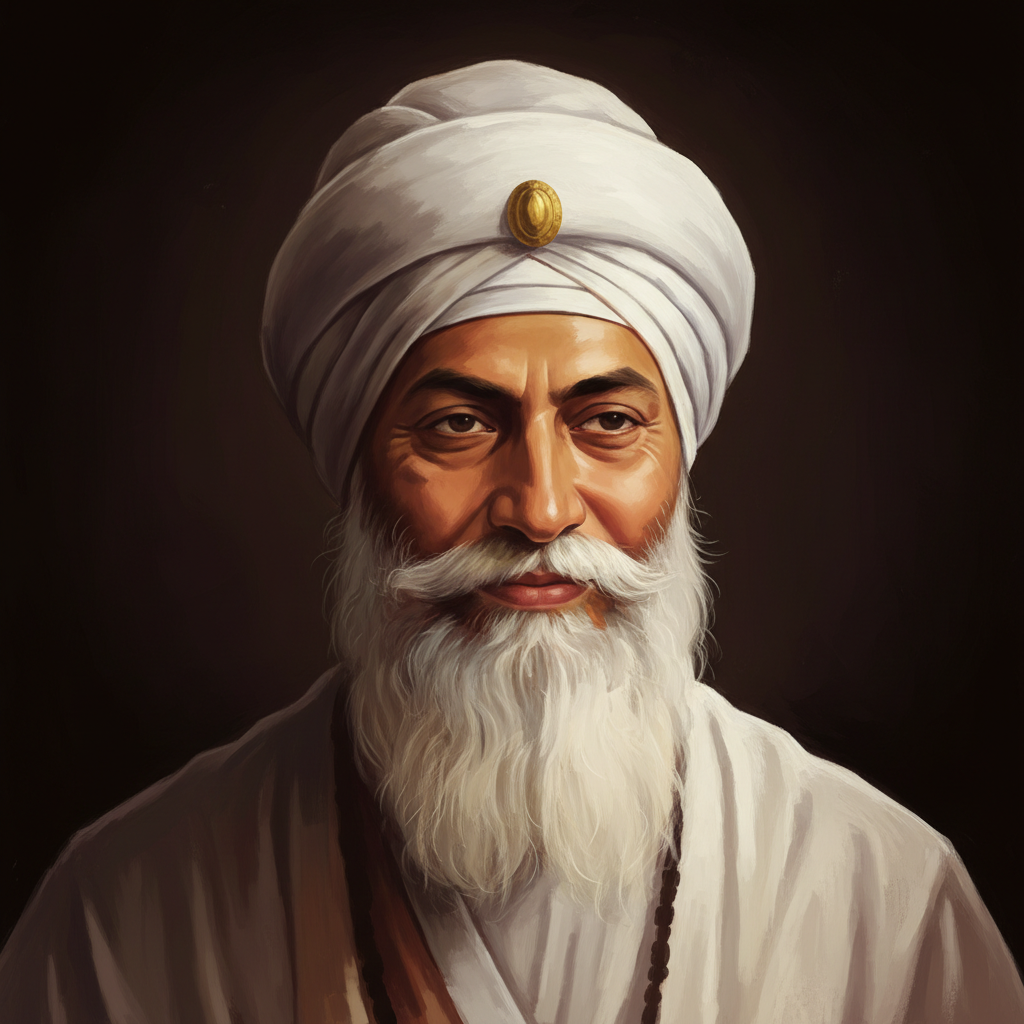
Guru Nanak — "The nights are wasted sleeping, and the days are wasted eating; the human spends…"
The nights are wasted sleeping, and the days are wasted eating; the human spends his life in vain.
The nights are wasted sleeping, and the days are wasted eating; the human spends his life in vain.
Click any product to generate a realistic preview. Up to 3 at a time.
* Initial load can take up to 90 seconds — revising the preview in another color is nearly instant.
"Those who have loved, have found God."
"Death would not be called bad, O people, if one knew how to truly die."
"Without the Naam, life is a waste."
"If a person bathes at sixty-eight holy places, but does not cleanse their mind, what good is it?"
"He who sees the Lord in all, he alone is truly wise."
Founder of Sikhism and the first of the Ten Sikh Gurus, whose teachings of one universal God and rejection of caste shaped Punjab. Closely associated with Kabir (mystical poet whose verses appear in the Sikh Guru Granth Sahib). For an intellectual contrast, see Brahmanical orthodoxy, the Hindu caste-and-ritual establishment of his era — Sikhism was founded as a deliberate alternative to both Hindu ritual hierarchy and Islamic exclusivism — Nanak's universalism was a structural rejection of caste and priestly mediation.
Found in 1 providers: deepseek
1 source checked
Most people drift through life on autopilot—sleeping through the night, eating and working through the day, and repeating the cycle without reflection or purpose. Nothing inherently meaningful gets added. The quote calls this a wasted existence: biological maintenance is not the same as living. Unless a person consciously pursues something higher—inner growth, service, truth, connection to the divine—their years slip by hollow, leaving the gift of human birth squandered.
Guru Nanak founded Sikhism on the conviction that ritual and routine are empty without remembrance of the divine (Naam Simran), honest labor (Kirat Karo), and sharing with others (Vand Chakko). A traveling teacher who walked four long udasis across Asia, he rejected idle renunciation and hollow householder comfort alike. This verse distills that critique: a life spent only feeding and sleeping the body betrays the rare human birth meant for spiritual awakening.
Guru Nanak (1469–1539) lived in Punjab under the late Delhi Sultanate and early Mughal era, a period of entrenched caste hierarchy, Hindu–Muslim tension, mechanical ritualism, and Brahmin and Mullah gatekeeping of the sacred. Ordinary people performed prescribed rites while being told the divine was unreachable without priests. Against this backdrop, warning that eating-and-sleeping existence is wasted was a radical call: every person, regardless of caste or creed, bore direct responsibility for an awakened life.
AI-generated insights based on extensive research and information for context. Factual errors? Email [email protected].
Your cart is empty