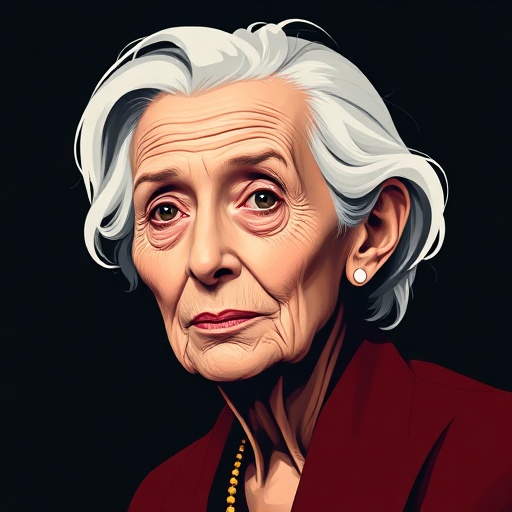
Jane Goodall — "What you do makes a difference, and you have to decide what kind of difference y…"
What you do makes a difference, and you have to decide what kind of difference you want to make.
What you do makes a difference, and you have to decide what kind of difference you want to make.
Click any product to generate a realistic preview. Up to 3 at a time.
* Initial load can take up to 90 seconds — revising the preview in another color is nearly instant.
"We must never give up hope. We must continue to fight for what is right."
"The more I learn about animals, the more I realize how much we have in common."
"My greatest joy is seeing young people get involved in conservation. They are the future."
"The world needs us to be better. We need to be better for the animals, for the planet, for ourselves."
"I have always believed that there is hope, even in the darkest of times."
British primatologist who in 1960 began the longest-running wild primate study at Gombe Stream, transforming our understanding of chimpanzees. Closely associated with Dian Fossey (mountain-gorilla researcher) and Birutė Galdikas (orangutan researcher; together with Goodall and Fossey one of Louis Leakey's 'Trimates'). For an intellectual contrast, see Walter Palmer, American dentist who killed Cecil the Lion in Zimbabwe in 2015 — Palmer represents the trophy-hunting tradition Goodall's life's work has been organized against — the colonial-era hunter-naturalist worldview that treated primates and big game as specimens or trophies, which Goodall's Roots & Shoots and Jane Goodall Institute exist specifically to displace.
Found in 1 providers: grok
1 source checked
Every action—or inaction—shapes the world around you. No one is neutral: your choices carry weight whether you acknowledge it or not. Rather than defaulting to passivity, it challenges you to be deliberate about your impact. The responsibility isn't merely to act, but to think critically about the direction of that action and consciously align it with your values and intentions.
Goodall spent decades at Gombe Stream, Tanzania, redefining humanity's understanding of chimpanzees and animal cognition. But witnessing accelerating habitat destruction firsthand, she pivoted from observer to global advocate, founding the Jane Goodall Institute and the Roots & Shoots youth program. This quote distills her personal arc: a scientist who chose intervention over detachment, and spent the rest of her life insisting others make that same conscious choice.
Goodall's career spans one of the most consequential environmental eras in history. She began fieldwork in 1960 as industrialization and deforestation accelerated globally. By the 1980s and 1990s, biodiversity loss, tropical deforestation, and climate change had become undeniable crises. Environmental activism surged—Earth Day, the Kyoto Protocol, NGO proliferation. Her message resonated because millions faced a stark choice: engage with an increasingly visible ecological emergency or look away.
AI-generated insights based on extensive research and information for context. Factual errors? Email [email protected].
Your cart is empty