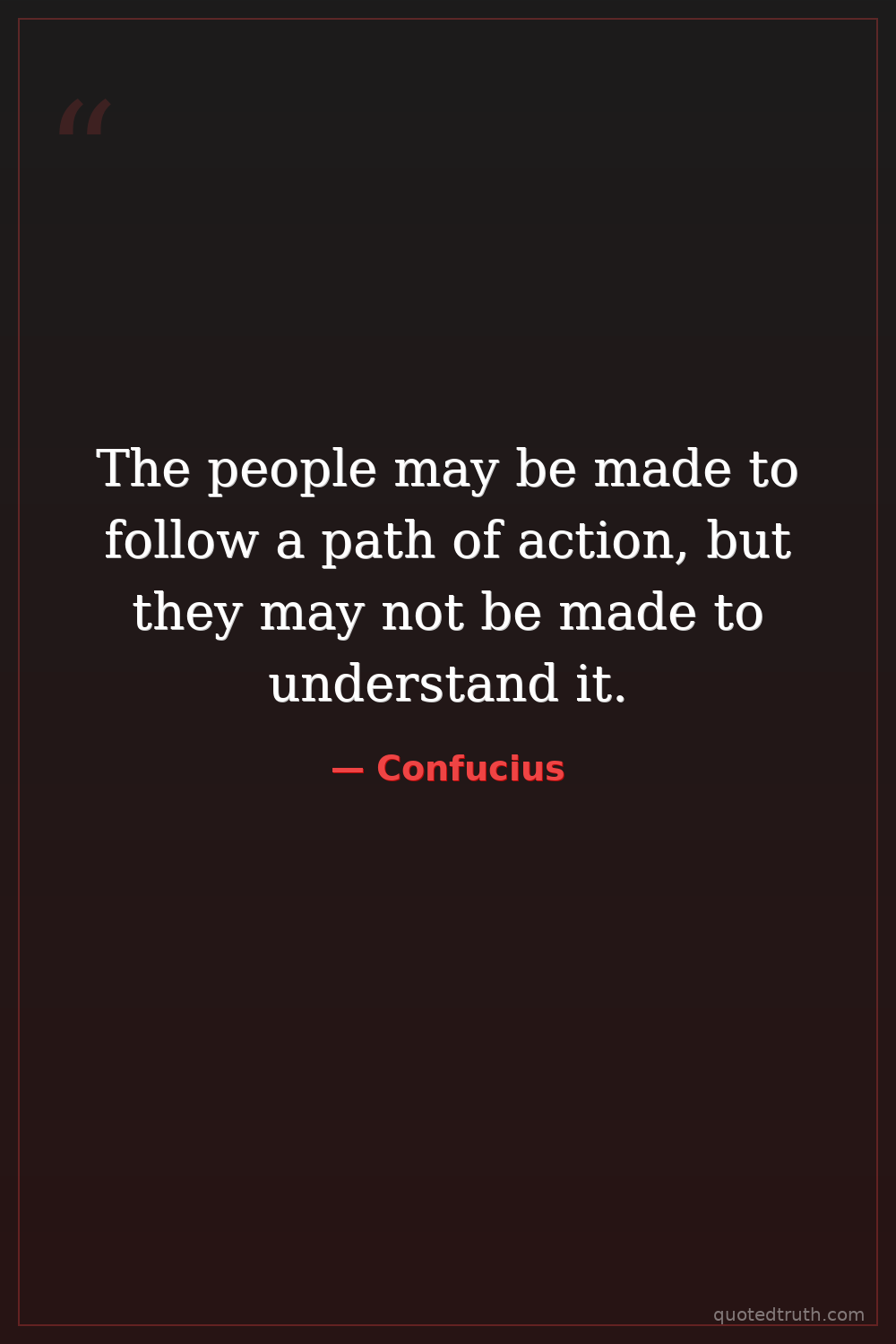
Confucius — "The people may be made to follow a path of action, but they may not be made to u…"
The people may be made to follow a path of action, but they may not be made to understand it.
The people may be made to follow a path of action, but they may not be made to understand it.
Click any product to generate a realistic preview. Up to 3 at a time.
* Initial load can take up to 90 seconds — revising the preview in another color is nearly instant.
"The cautious seldom err."
"When you see a good man, try to emulate his example, and when you see a bad man, search yourself for his faults."
"To worship ancestors whom one does not know is to be presumptuous."
"I have never seen anyone who loved virtue as much as they loved sex."
"If a man does not say to himself, 'What shall I think of this? What shall I think of this?' I can make nothing of him."
Chinese philosopher and teacher whose teachings (compiled by his students in the Analects) became the foundational ethical framework of East Asian civilization for 2,500 years. Closely associated with Mencius (his most-influential follower a century later). For an intellectual contrast, see Laozi, near-contemporary Chinese sage and Tao Te Ching author — Confucius systematized social order through ritual and family hierarchy; Laozi's Taoist effortless-action philosophy argued such systems were the disease, not the cure. The two founding poles of Chinese moral philosophy — every East Asian moral tradition since has positioned itself between them.
The standard scholarly entry points to Confucius's work: Philip J. Ivanhoe (Georgetown, Chinese philosophy) — Confucian Moral Self Cultivation (2000); Edward Slingerland (UBC, Asian Studies) — Effortless Action: Wu-wei as Conceptual Metaphor (2003); Tu Weiming (Harvard, Confucian scholar) — Confucian Thought: Selfhood as Creative Transformation (1985). These are the works graduate seminars cite when teaching Confucius.
Found in 1 providers: deepseek
1 source checked
Ordinary people can be directed to act in certain ways, but getting them to genuinely grasp the reasoning behind those actions is far harder. Compliance is achievable through guidance, custom, or authority, but true understanding requires education, reflection, and intellectual capacity that cannot simply be handed down. The saying draws a sharp line between behavior that can be shaped externally and comprehension that must be developed internally over time.
Confucius spent his life as a teacher and political advisor who believed deeply in moral cultivation through ritual and example. Having tutored disciples from varied backgrounds, he recognized that most followers absorbed proper conduct through practice long before understanding its principles. This reflects his hierarchical view of society and his conviction that rulers lead by virtuous example, trusting that correct action precedes, and sometimes substitutes for, full philosophical comprehension among the governed.
Confucius lived during the Spring and Autumn period of the Zhou dynasty, an era of collapsing feudal order, constant warfare between states, and deteriorating ritual propriety. Ordinary peasants were illiterate, bound to agricultural labor, and excluded from scholarly learning reserved for aristocrats. Governance depended on ritual, custom, and hereditary authority rather than mass education. In this context, guiding people through established paths of conduct was practical statecraft, while universal philosophical understanding was simply inconceivable.
AI-generated insights based on extensive research and information for context. Factual errors? Email [email protected].
Your cart is empty