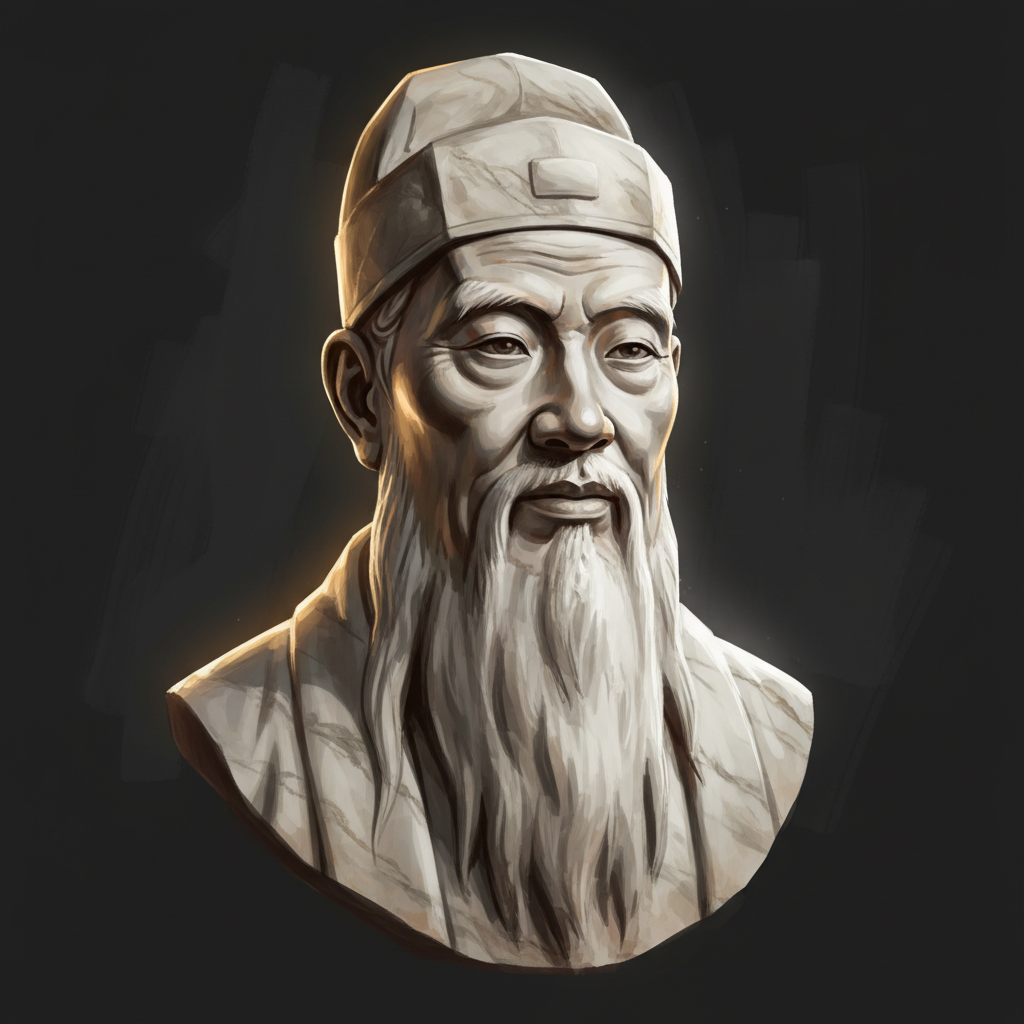
Confucius — "The Master said, 'It is not easy to find a man who has learned for three years w…"
The Master said, 'It is not easy to find a man who has learned for three years without having his thoughts bent on learning.'
The Master said, 'It is not easy to find a man who has learned for three years without having his thoughts bent on learning.'
Click any product to generate a realistic preview. Up to 3 at a time.
* Initial load can take up to 90 seconds — revising the preview in another color is nearly instant.
"Reviewing the old as a means of understanding the new — such a person can be a teacher."
"If a man does not say 'What shall I do? What shall I do?', I can do nothing with him."
"When you know a thing, to hold that you know it; and when you do not know a thing, to allow that you do not know it—this is knowledge."
"The gentleman is not a tool."
"First he behaves properly and then he speaks, so that his words follow his actions."
Chinese philosopher and teacher whose teachings (compiled by his students in the Analects) became the foundational ethical framework of East Asian civilization for 2,500 years. Closely associated with Mencius (his most-influential follower a century later). For an intellectual contrast, see Laozi, near-contemporary Chinese sage and Tao Te Ching author — Confucius systematized social order through ritual and family hierarchy; Laozi's Taoist effortless-action philosophy argued such systems were the disease, not the cure. The two founding poles of Chinese moral philosophy — every East Asian moral tradition since has positioned itself between them.
The standard scholarly entry points to Confucius's work: Philip J. Ivanhoe (Georgetown, Chinese philosophy) — Confucian Moral Self Cultivation (2000); Edward Slingerland (UBC, Asian Studies) — Effortless Action: Wu-wei as Conceptual Metaphor (2003); Tu Weiming (Harvard, Confucian scholar) — Confucian Thought: Selfhood as Creative Transformation (1985). These are the works graduate seminars cite when teaching Confucius.
Found in 1 providers: grok
1 source checked
Confucius observes that it is rare to find someone who studies for three full years without starting to think about the rewards learning can bring—status, a job, or recognition. Most students eventually shift from loving knowledge itself to chasing what it can get them. The saying praises the unusual person who stays devoted to learning purely for its own sake, without letting ambition or practical payoff corrupt their motivation.
Confucius spent his life as a teacher who believed learning should cultivate virtue, not merely secure office. Though he himself sought government positions to apply his ideals, he repeatedly criticized students who studied only to earn salaries. He praised disciples like Yan Hui, who lived in poverty yet never wavered from study. This remark captures his lifelong frustration that most pupils treated his school as a career ladder rather than a path to becoming a junzi, a morally refined person.
During the Spring and Autumn period (roughly 551–479 BCE), the Zhou dynasty's authority was collapsing and rival states competed for talent. Education, once restricted to aristocrats, was opening to commoners who saw literacy and ritual training as a ticket into official service. Confucius ran one of the first private schools admitting students by merit, but the era's instability made most learners pragmatic credential-seekers. His complaint reflects this tension between ancient ideals of self-cultivation and a new marketplace for bureaucratic skill.
AI-generated insights based on extensive research and information for context. Factual errors? Email [email protected].
Your cart is empty