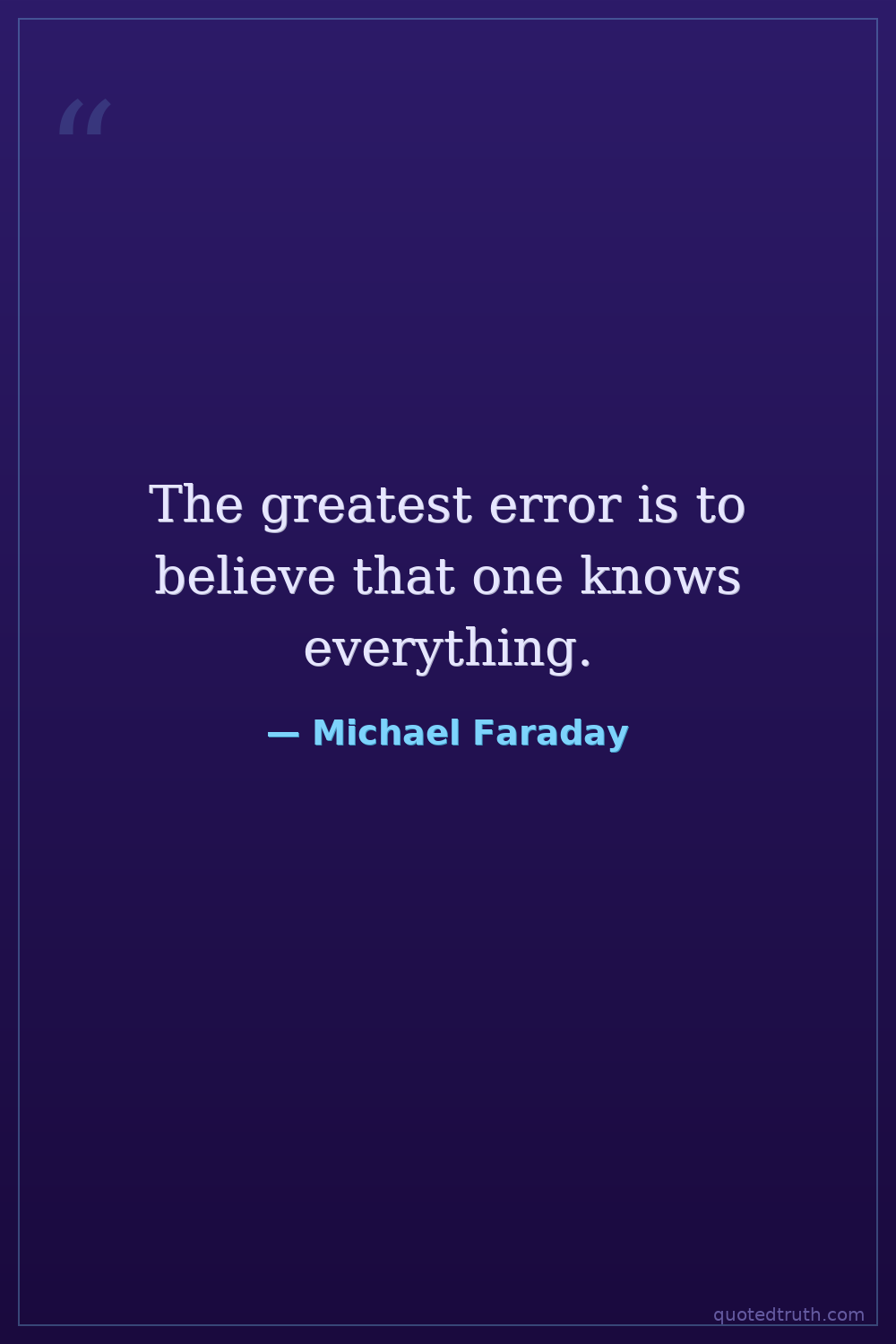
Michael Faraday — "The greatest error is to believe that one knows everything."
The greatest error is to believe that one knows everything.
The greatest error is to believe that one knows everything.
Click any product to generate a realistic preview. Up to 3 at a time.
* Initial load can take up to 90 seconds — revising the preview in another color is nearly instant.
"Work, finish, publish."
"The five essential entrepreneurial skills for success are concentration, discrimination, organization, innovation and communication."
"The greatest pleasure in life is to discover something new."
"The book of nature is written in the language of mathematics."
"It may be a weed instead of a fish that, after all my labour, I at last pull up."
Attributed, similar to Pasteur, reflecting a universal scientific humility.
Date: Mid 19th Century (approx.)
InspirationalFound in 1 providers: grok
1 source checked
Claiming to know everything is the worst mistake a person can make. True understanding begins with admitting what you do not know. Overconfidence closes the mind, stops questions, and blocks learning, while humility keeps curiosity alive. The person who thinks they have all the answers stops looking for better ones, misses their own blind spots, and ends up further from the truth than someone who openly accepts uncertainty.
Faraday rose from bookbinder's apprentice to one of history's greatest experimentalists without formal mathematical training, so humility was not a pose but a working method. He tested assumptions constantly, kept meticulous lab notebooks, and discarded pet theories when data disagreed. His discovery of electromagnetic induction came from questioning what textbooks treated as settled. A devout Sandemanian, he distrusted intellectual pride, refused a knighthood, and insisted science advances only when researchers admit ignorance.
Faraday worked during the early-to-mid 1800s industrial revolution, when steam, electricity, and chemistry were rapidly overturning centuries of inherited certainty. Gentleman-scientists often defended prestige over evidence, and rigid theoretical schools clashed at the Royal Institution where he lectured. Meanwhile positivist confidence was rising that science would soon explain everything. Faraday's warning against knowing-it-all pushed back on that swagger, urging patient experimentation over armchair authority in a century drunk on its own progress.
AI-generated insights based on extensive research and information for context. Factual errors? Email [email protected].
Your cart is empty