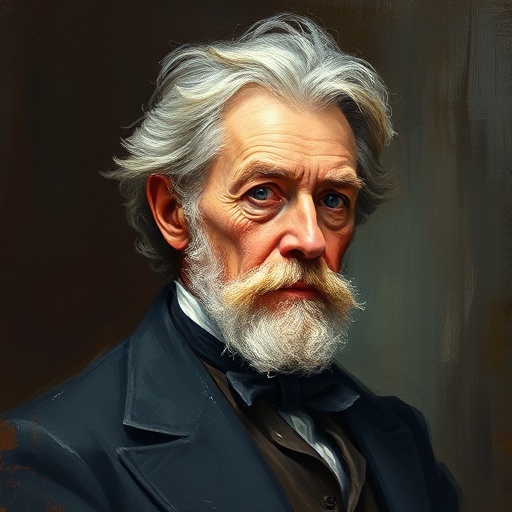
Michael Faraday — "The greatest pleasure in life is to discover something new."
The greatest pleasure in life is to discover something new.
The greatest pleasure in life is to discover something new.
Click any product to generate a realistic preview. Up to 3 at a time.
* Initial load can take up to 90 seconds — revising the preview in another color is nearly instant.
"It may be a weed instead of a fish that, after all my labour, I at last pull up."
"The more we know of the laws of nature, the more we are led to believe in the wisdom, intelligence, and design of God."
"Nothing is too wonderful to be true, if it be consistent with the laws of nature; and in such things as these, experiment is the best test of consistency."
"A man who is certain he is right is almost sure to be wrong."
"Nothing is too wonderful to be true if it be consistent with the laws of nature."
Attributed, expressing the excitement of scientific breakthroughs.
Date: Mid 19th Century (approx.)
EducationalFound in 1 providers: grok
1 source checked
Real satisfaction comes from uncovering knowledge or experiences that did not exist for you before. It places the thrill of finding out above wealth, comfort, or recognition. The saying frames curiosity and exploration as the highest reward a person can chase, suggesting that a life spent learning and encountering the unknown will always feel richer than one centered on accumulating things or chasing approval.
Faraday lived this claim. Born poor and largely self-taught, he rose from bookbinder's apprentice to one of history's great experimentalists, discovering electromagnetic induction, diamagnetism, and the laws of electrolysis. He refused a knighthood and the presidency of the Royal Society, preferring the lab bench. His notebooks overflow with the delight of fresh results, and his Christmas Lectures aimed to spark that same pleasure of discovery in ordinary listeners, especially children.
Faraday worked through the first half of the 1800s, the thick of Britain's Industrial Revolution, when steam, telegraphy, and emerging electrical science were rewriting daily life. The Royal Institution in London turned experimental demonstrations into public spectacle, and gentleman-scientists were professionalizing into paid researchers. Discovery carried national prestige and practical payoff, powering factories, ships, and eventually electric grids. In that charged climate, prizing the act of finding something new was both a personal creed and a cultural mood.
AI-generated insights based on extensive research and information for context. Factual errors? Email [email protected].
Your cart is empty