What it means
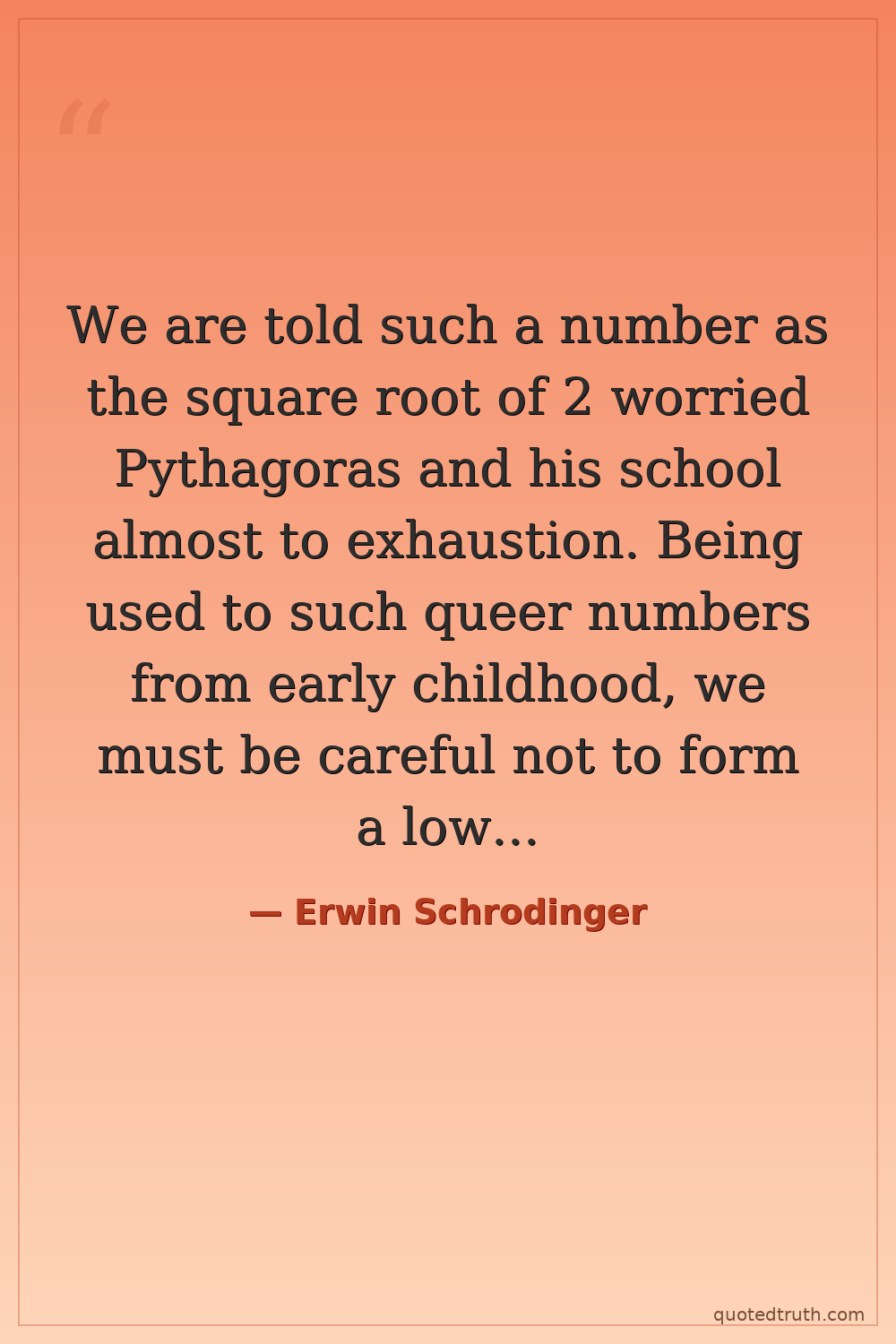
Early mathematicians like Pythagoras were deeply troubled by irrational numbers like the square root of 2, which cannot be expressed as a simple fraction. We shouldn't judge them harshly for this anxiety—because we grow up casually accepting such numbers, we forget how genuinely unsettling they were to minds encountering them fresh. Their distress reflected profound mathematical sensitivity, not weakness.
Relevance to Erwin Schrodinger
Schrödinger, architect of quantum wave mechanics, spent his career confronting mathematics that defied classical intuition—wave functions, probability amplitudes, complex-number solutions describing physical reality. His empathy for Pythagorean anxiety mirrors his own experience normalizing deeply counterintuitive mathematics. As someone who made 'queer numbers' the foundation of modern physics, he understood viscerally how mathematical strangeness demands intellectual courage.
The era
Schrödinger wrote amid early 20th-century physics' revolutionary upheaval—quantum mechanics and relativity dismantled centuries of intuitive certainty. Physicists routinely wrestled with mathematics that seemed to violate common sense: probability waves, uncertainty principles, imaginary-number operators. This climate made historical mathematical crises newly relevant, reminding scientists that confronting disturbing abstractions has always been the price of genuine understanding.
AI-generated insights based on extensive research and information for context. Factual errors? Email [email protected].