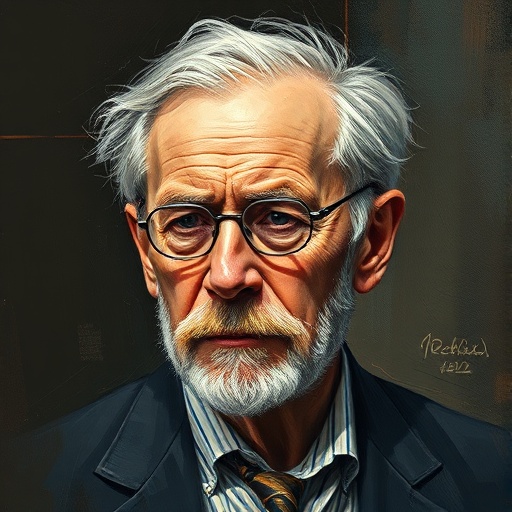
Erwin Schrodinger — "Quantum physics thus reveals a basic oneness of the universe."
Quantum physics thus reveals a basic oneness of the universe.
Quantum physics thus reveals a basic oneness of the universe.
Click any product to generate a realistic preview. Up to 3 at a time.
* Initial load can take up to 90 seconds — revising the preview in another color is nearly instant.
"If we were bees, ants, or Lacedaemonian warriors, to whom personal fear does not exist and cowardice is the most shameful thing in the world, warring would go on forever. But luckily we are only men —…"
"The world is not something that exists independently of us. It is something that we create."
"The future is uncertain, but that is precisely what makes it interesting."
"Science without religion is lame, religion without science is blind."
"Consciousness is a singular of which the plural is unknown."
Austrian physicist who shared the 1933 Nobel for the wave equation that bears his name and the famous cat thought-experiment. Closely associated with Werner Heisenberg (matrix-mechanics rival who reached the same physics by different math) and Albert Einstein (his pen-pal on quantum interpretation). For an intellectual contrast, see Niels Bohr, Danish physicist and architect of the Copenhagen interpretation — Schrödinger's cat thought-experiment was specifically designed to ridicule Bohr's 'observer-dependent reality' reading of quantum mechanics — Schrödinger thought the Copenhagen interpretation was absurd; the cat was meant as reductio ad absurdum.
A statement connecting quantum mechanics to a more unified, holistic view of existence.
Date: Unknown, likely from his philosophical writings
ShockingFound in 1 providers: gemini
1 source checked
Everything in the universe is fundamentally interconnected at the deepest level. Quantum mechanics shows that particles don't exist as isolated, independent objects but are entangled aspects of a unified whole. What appears as separate things at human scales dissolves at the quantum level into shared states and non-local correlations, suggesting reality is one continuous, indivisible fabric rather than a collection of distinct pieces.
Schrödinger developed wave mechanics in 1926, describing particles as probability waves rather than discrete objects. His famous cat paradox illustrated quantum superposition's philosophical strangeness. He wrote 'What is Life?' exploring consciousness and unity. His equation showed matter behaves as interconnected waves, directly supporting this oneness idea. Late in life he deeply studied Vedantic philosophy, which similarly teaches that individual existence is an illusion within universal consciousness.
The 1920s-1950s saw quantum mechanics overturn classical Newtonian physics, which assumed a mechanical universe of separate billiard-ball particles. Einstein, Bohr, and Heisenberg debated whether quantum weirdness reflected reality or measurement limits. Entanglement experiments suggested particles remained connected across distances. Post-WWII physicists grappled with what their equations meant philosophically, making Schrödinger's holistic interpretation both scientifically grounded and culturally resonant amid atomic-age anxieties.
AI-generated insights based on extensive research and information for context. Factual errors? Email [email protected].
Your cart is empty