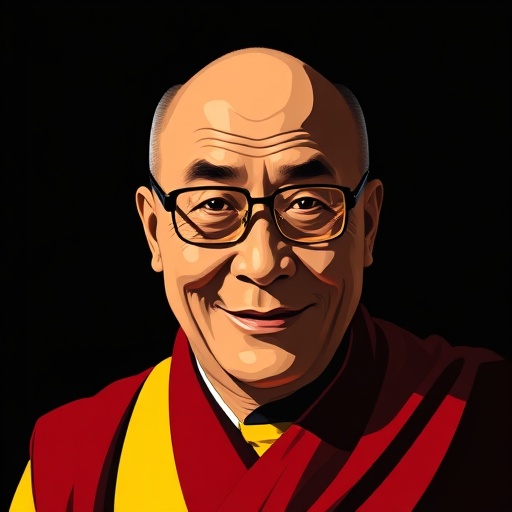
Dalai Lama (14th) — "I am a Marxist monk."
I am a Marxist monk.
I am a Marxist monk.
Click any product to generate a realistic preview. Up to 3 at a time.
* Initial load can take up to 90 seconds — revising the preview in another color is nearly instant.
"I think the purpose of life is to be happy."
"I am a very optimistic person. I believe that humanity has the potential to create a better world."
"I think the most important thing is to have compassion. Compassion is the foundation of all good things."
"My message is always the same: love, compassion, and forgiveness."
"When we meet real tragedy in life, we can react in two ways — either by losing hope and falling into self-destructive habits, or by using the challenge to find our inner strength."
Found in 1 providers: deepseek
1 source checked
The quote describes two identities that seem contradictory but aren't. The Dalai Lama values Marxist economic thinking — its focus on reducing inequality, sharing resources, and protecting the poor — while remaining a Buddhist monk devoted to compassion. He explicitly separates Marxist economic theory from communist political regimes that suppress religion and freedom. The statement argues that economic justice and spiritual practice aren't opposites; both center on alleviating human suffering.
Tenzin Gyatso, born 1935, fled Chinese-occupied Tibet in 1959 and has spent his life advocating for Tibetan freedom and universal compassion. His Buddhism centers on reducing suffering for all beings — a goal he finds echoed in Marxist concern for the dispossessed. Despite China's communist government being his chief political adversary, he separates its authoritarianism from economic Marxism, repeatedly stating in interviews that capitalism's unchecked greed directly contradicts the compassion his faith demands.
The quote emerged in a world shaped by Cold War ideology, where capitalism and communism were treated as total opposites. After 1989's Soviet collapse, neoliberal capitalism dominated, widening global inequality. Meanwhile, China's communist government — which occupied Tibet — persecuted religion. The Dalai Lama's statement was deliberately disruptive: it separated Marxist economic critique from authoritarian communism, challenging audiences on both sides to reconsider whether economic justice and spiritual freedom must be enemies.
AI-generated insights based on extensive research and information for context. Factual errors? Email [email protected].
Your cart is empty