Enrico Fermi — "Never underestimate the joy people derive from hearing something they already kn…"
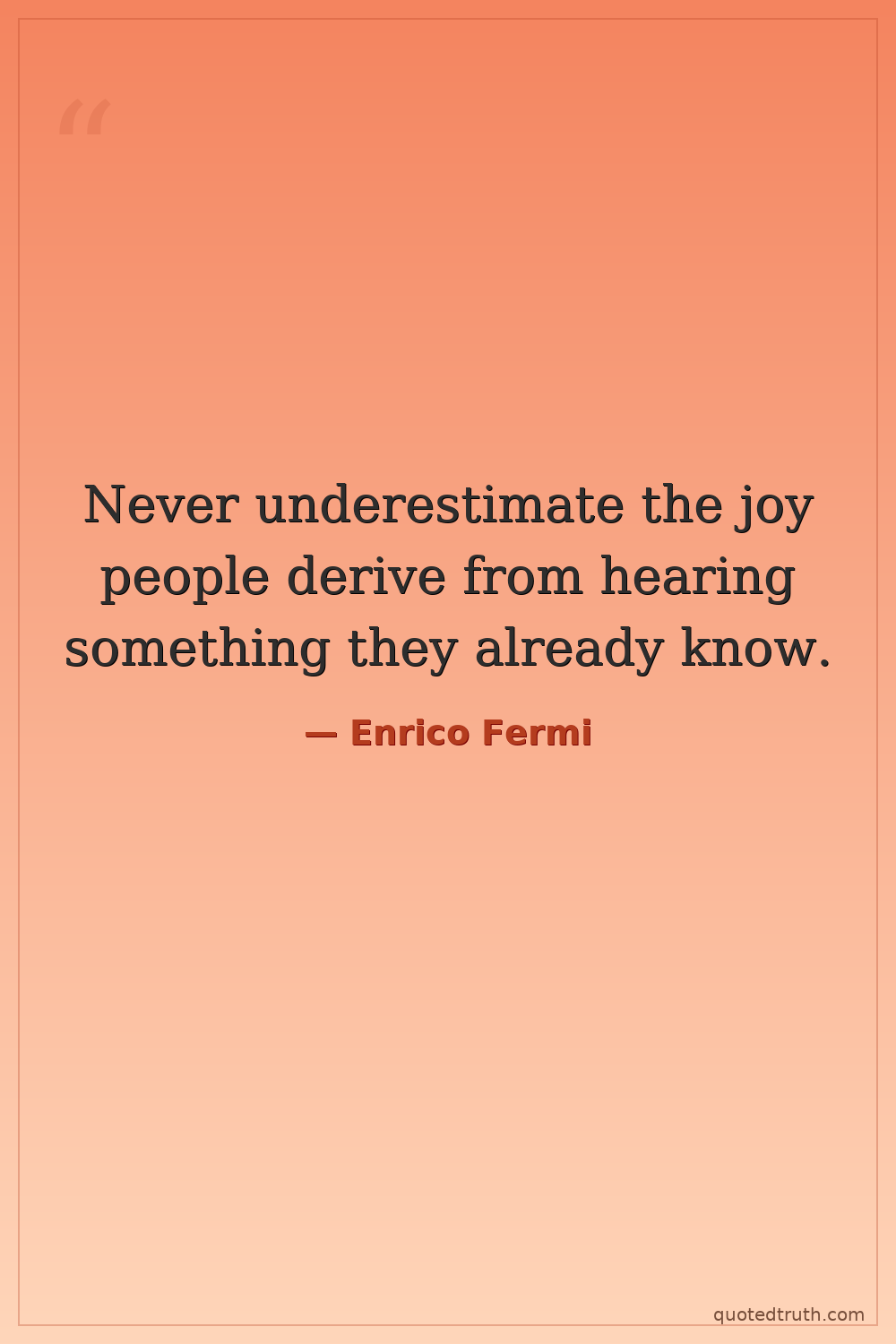
Never underestimate the joy people derive from hearing something they already know.
Never underestimate the joy people derive from hearing something they already know.
Click any product to generate a realistic preview. Up to 3 at a time.
* Initial load can take up to 90 seconds — revising the preview in another color is nearly instant.
"It is very hard to be famous and still do good work."
"We must always strive to use our knowledge for the betterment of humanity, and not for its destruction."
"I believe that science is a universal language, and that it can bring people together from all over the world."
"The more you know, the more you realize you don't know."
"The best way to predict the future is to create it."
Found in 1 providers: gemini
1 source checked
People take genuine pleasure in confirmation — when information aligns with what they already believe or understand, it feels satisfying and validating. This warns against treating familiar content as redundant or beneath your audience. Whether teaching, persuading, or communicating, revisiting known ideas creates comfort, builds confidence, and reinforces understanding. Recognition triggers positive emotion. Don't skip what your audience knows; use it as a foundation, because repetition carries real psychological value.
Fermi was celebrated not just as a physicist but as an exceptional teacher at the University of Chicago and Columbia. His famous estimation problems built new reasoning atop things students already understood intuitively. Leading Chicago Pile-1, he communicated nuclear concepts to engineers and military officials with vastly different expertise. His pedagogical strength was precisely anchoring the unfamiliar in the familiar, making him one of the most effective science communicators of the twentieth century.
Fermi worked through the 1930s–1950s, when physics underwent revolutionary upheaval — quantum mechanics, fission, and the atomic bomb reshaped civilization almost overnight. Scientists suddenly had to explain nuclear concepts to politicians, generals, and a frightened public with no physics background. The Manhattan Project required physicists to brief non-specialists constantly. Post-war, the Atomic Age demanded broad public science education. In that climate, respecting your audience's existing knowledge — and building on it — was not just good pedagogy but a practical necessity.
AI-generated insights based on extensive research and information for context. Factual errors? Email [email protected].
Your cart is empty