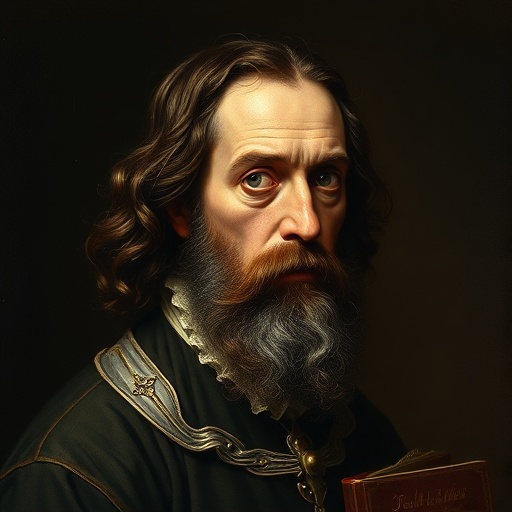
Johannes Kepler — "I have a mind that is always seeking new things."
I have a mind that is always seeking new things.
I have a mind that is always seeking new things.
Click any product to generate a realistic preview. Up to 3 at a time.
* Initial load can take up to 90 seconds — revising the preview in another color is nearly instant.
"I have often been poor, but I have always been rich in spirit."
"The works of God are beautiful and great; let us, therefore, with all our might, strive to know them."
"I would rather be a good Christian than a good astronomer."
"I have been a wanderer, but I have always found my way back to God."
"The human mind is capable of understanding the divine plan."
Found in 1 providers: grok
1 source checked
The speaker describes themselves as endlessly curious, driven by a restless hunger to discover, learn, and explore ideas that are unfamiliar. Rather than settling into what they already know, their mind naturally reaches toward the unknown, pursuing fresh questions, patterns, and possibilities. It captures the temperament of a lifelong investigator whose satisfaction comes not from comfortable certainty but from the ongoing pursuit of understanding something new.
Kepler embodied this restlessness throughout his career. Starting as a theology student, he pivoted to astronomy, then relentlessly reworked Tycho Brahe's Mars data until he overturned 2,000 years of circular-orbit dogma with elliptical orbits. He explored optics, crystal geometry, musical harmony, and logarithms alongside planetary motion. His three laws emerged only because he refused to stop probing discrepancies others dismissed, chasing mathematical truth across disciplines.
In the early 17th century, Europe was mid-Scientific Revolution. Copernicus's heliocentric model was still contested, Galileo was turning telescopes skyward, and the Thirty Years' War disrupted scholarship across the continent. The Catholic Church had condemned Copernicanism, and Kepler, a Lutheran, faced religious exile and his mother's witchcraft trial. Yet this turbulent era rewarded intellectual boldness: print culture spread ideas rapidly, and patronage courts funded natural philosophers willing to challenge Aristotelian orthodoxy.
AI-generated insights based on extensive research and information for context. Factual errors? Email [email protected].
Your cart is empty