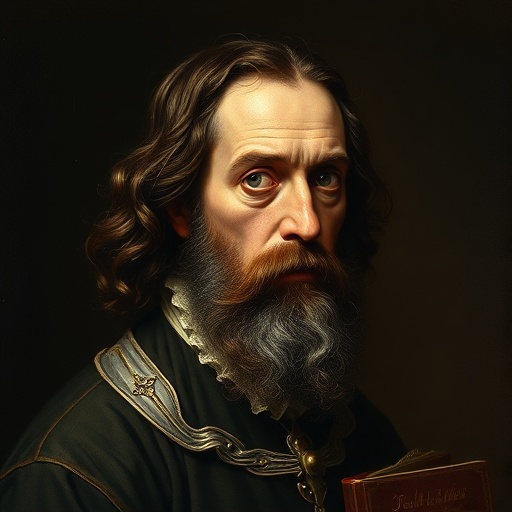
Johannes Kepler — "I have often been poor, but I have always been rich in spirit."
I have often been poor, but I have always been rich in spirit.
I have often been poor, but I have always been rich in spirit.
Click any product to generate a realistic preview. Up to 3 at a time.
* Initial load can take up to 90 seconds — revising the preview in another color is nearly instant.
"I also ask you my friends not to condemn me entirely to the mill of mathematical calculations, and allow me time for philosophical speculations, my only pleasures."
"I am a Lutheran astrologer, I throw away the nonsense and keep the hard kernel."
"God gives every animal the means of saving its life—why object if he gives astrology to the astronomer?"
"I am a Christian. I believe in the Trinity."
"I have been a teacher, and I have learned much from my students."
Found in 1 providers: grok
1 source checked
Material wealth and inner wealth are two different things. A person can lack money, possessions, or worldly success yet still possess a rich interior life filled with curiosity, conviction, faith, love, and purpose. The speaker acknowledges frequent financial hardship but refuses to equate that with personal poverty, insisting that what truly matters—character, imagination, and spiritual vitality—cannot be measured by a bank account.
Kepler endured chronic financial distress his entire career. His salary from Emperor Rudolf II was rarely paid, he struggled to support his family, defended his mother from witchcraft charges at great personal cost, and lost patrons repeatedly. Yet he pursued planetary motion with almost religious devotion, believing he was uncovering God's geometric blueprint. His three laws, Harmonices Mundi, and relentless mathematical labor reflect a man whose inner life vastly outweighed his meager material circumstances.
The early 1600s brought the Thirty Years' War, plague, religious persecution, and economic chaos across the Holy Roman Empire. Scholars depended on unreliable royal patronage, and Protestants like Kepler were often displaced by Counter-Reformation pressures. Science was not yet a paid profession; natural philosophers lived precariously between courts. Simultaneously, the Scientific Revolution was dawning, and thinkers drew meaning from faith and discovery rather than wealth, making spiritual richness a common consolation amid material scarcity.
AI-generated insights based on extensive research and information for context. Factual errors? Email [email protected].
Your cart is empty