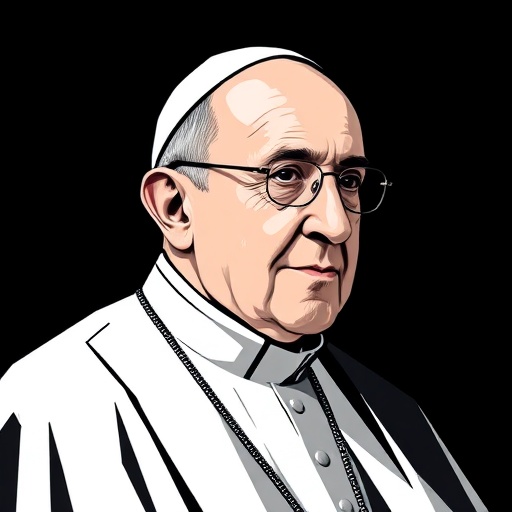
Pope Francis — "This economy kills."
This economy kills.
This economy kills.
Click any product to generate a realistic preview. Up to 3 at a time.
* Initial load can take up to 90 seconds — revising the preview in another color is nearly instant.
"I like to talk to people, to go out into the street. I like to be a street priest."
"I'm a bit of a glutton."
"We are not living in an era of change, but a change of era."
"A person once asked me, in a provocative manner, if I approved of homosexuality. I replied with another question: 'Tell me: when God looks at a gay person, does he endorse the existence of this person…"
"The powerful of the earth, when they do not want to see problems, they cover them up. They hide them."
First Latin American and Jesuit pope (2013-), who has steered the Catholic Church toward pastoral inclusion on LGBTQ pastoral care, divorced Catholics, and climate. Closely associated with Pope John XXIII (the Vatican II reformer pope) and Cardinal Walter Kasper (his theological ally on pastoral reform). For an intellectual contrast, see Cardinal Raymond Burke, American traditionalist cardinal, former head of the Vatican Apostolic Signatura — Burke is the public face of Catholic traditionalism that views Francis's pastoral approach as doctrinally dangerous — he has formally challenged Amoris Laetitia and other Francis reforms.
Found in 1 providers: deepseek
1 source checked
The quote indicts the modern global economy—driven by financial speculation, deregulated markets, and profit maximization—for causing literal death. When wealth concentrates among elites while millions lack food, healthcare, and shelter, the system becomes lethal. Francis argues that an economy which excludes and discards the poor is not a neutral technical mechanism but a moral choice that kills real people through poverty, deprivation, and structural violence.
Jorge Bergoglio grew up in Buenos Aires amid Latin America's cycles of poverty and IMF-driven austerity. As Archbishop, he rode public transit, lived modestly, and ran soup kitchens. His Jesuit formation centers service to the marginalized. Elected Pope in 2013, he chose the name Francis after St. Francis of Assisi, explicitly signaling a papacy defined by simplicity and solidarity with those crushed by exclusionary economic systems.
Written in Evangelii Gaudium (2013), five years after the global financial crisis, Francis addressed a world where banks received trillion-dollar bailouts while governments imposed austerity on citizens. The Occupy movement had just exposed wealth concentration; Piketty's research was documenting widening inequality. Global child poverty remained endemic, and wage stagnation defined recovery for millions—making the claim that unchecked markets produce death both provocative and statistically defensible.
AI-generated insights based on extensive research and information for context. Factual errors? Email [email protected].
Your cart is empty